
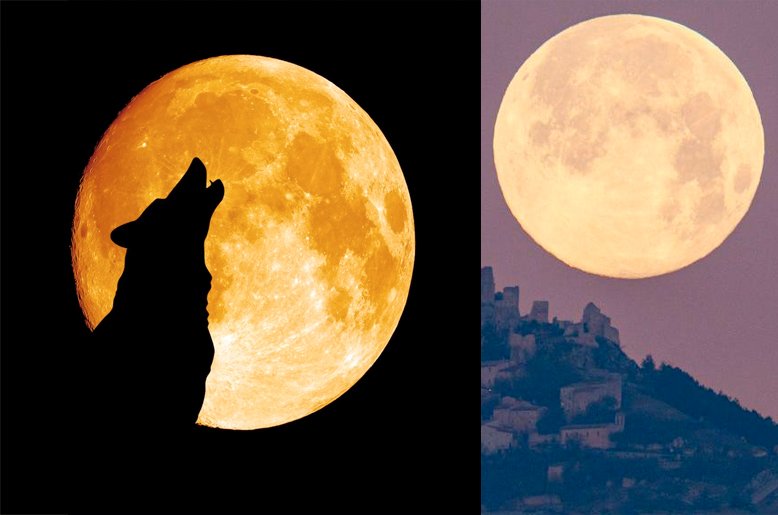
Web Desk: Skywatchers across Pakistan and around the world will see the first full moon and supermoon of 2026 this weekend, as the January “Wolf Moon” brightens the night sky and marks a major astronomical moment early in the new year.
Although the Moon reaches its exact full phase early on Saturday, January 3, astronomers say it will appear nearly full for several nights, making evening hours the best time for viewing. The Moon will rise shortly after sunset and remain visible well into the night.
The January full moon is commonly called the Wolf Moon, a name linked to Indigenous North American traditions that associated the season with wolves heard howling during harsh winter nights. In parts of Europe, the same moon has been known as the Cold Moon or Hard Moon, while early Anglo-Saxon calendars referred to it as the Moon After Yule.
This full moon is classified as a supermoon because it occurs close to perigee, the point at which the Moon is nearest to Earth in its slightly oval-shaped orbit. During this event, the Moon will sit roughly 362,000 kilometers from Earth, causing it to appear noticeably brighter and marginally larger than an average full moon.
Astronomers note that the January supermoon concludes a rare sequence of four consecutive supermoons that began in late 2025. After this weekend, observers will not see another supermoon until November 2026.
In Pakistan, the Space and Upper Atmosphere Research Commission (SPARCO) said the Moon will rise at approximately 5:51 p.m. on Saturday, with illumination reaching nearly full. Clear views are also expected on the evening of January 4, depending on weather conditions.
Observers are advised to face east shortly after sunset. When the Moon first appears near the horizon, it may look unusually large due to the “moon illusion,” a visual effect that makes low-lying moons seem oversized. Atmospheric conditions may also give the Moon a warm yellow or orange tint.
The weekend sky will feature an additional highlight as Jupiter appears close to the Moon, creating a striking pairing. The two objects will appear closest on the evening of January 3, when the gas giant shines brightly despite the Moon’s glare. Jupiter’s increasing brilliance is due to its approach toward opposition later in January.
Other easily visible features near the Moon include the constellation Orion, the bright star Sirius, Gemini’s twin stars Castor and Pollux and the Pleiades and Hyades star clusters.
Astronomers say the Wolf Moon will follow one of its highest arcs across the sky this year in the Northern Hemisphere. Because full moons occupy the opposite position of the Sun, and the Sun remains low during winter, the Moon climbs higher and stays visible longer overnight.
No telescopes or binoculars are needed to enjoy the event, and even urban observers should have clear views despite light pollution. Scientists say the Wolf Moon offers a vivid and accessible way to begin the astronomical year, encouraging people to step outside and look up as 2026 gets underway.
Read more: Good news for Pakistanis seeking passports


