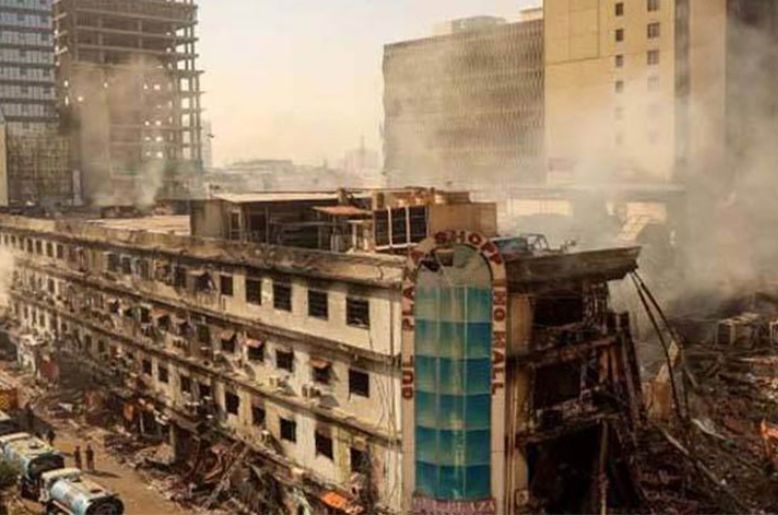
In the Gul Plaza fire case in Karachi, police have submitted a challan to the court, holding the Gul Plaza Association responsible while finding no negligence on the part of the Karachi Metropolitan Corporation (KMC), Fire Brigade, or Civil Defence Department.
According to the police, the challan raises questions about fire safety arrangements at Gul Plaza and alleged negligence by the building management. Statements regarding security arrangements at the shops and within the building have also been included in the challan. During the investigation, police collected various pieces of evidence, including CCTV footage, NVR, USB and DVR recordings. The statements of 87 witnesses have also been included in the challan.
According to police, a forensic examination found no explosive material among the recovered items, nor were traces of flammable liquids detected. However, residues consistent with burnt materials were found on some of the items examined. The police have submitted the challan to the court for further legal proceedings and orders.
The fire at Gul Plaza broke out on the night of January 17, 2026, and took nearly two days to completely extinguish. More than 70 people lost their lives in the incident, while parts of the building collapsed and the plaza sustained extensive damage. The Sindh government established a judicial commission in February 2026, headed by Sindh High Court Justice Agha Faisal, to investigate the incident.
The commission submitted its sealed report, along with the complete record, to the Law Department in April. The 78-page report was made public on August 30, although it was unsigned at the time of its release. The judicial commission did not hold any single individual, department, or institution solely responsible for the fire. Instead, it described the tragedy as a “systemic and overall failure” of the provincial and local government system. According to the report, the necessary legal and administrative procedures were already in place, but they were not effectively implemented.
The commission identified institutional shortcomings involving the KMC, Fire Brigade, Sindh Building Control Authority (SBCA), Rescue 1122, Civil Defence Department, district administration, and other relevant institutions.
The report stated that the emergency response system lacked adequate training, communication mechanisms, and equipment to deal with an incident of such a large scale. It also found that existing requirements related to fire safety, building control, and inspections had not been effectively enforced.
According to the commission, building-control records were incomplete or unclear. Despite previous audits and inspections, corrective measures were not taken. The report also noted that communication mechanisms remained largely paper-based. The commission identified blocked routes, obstructed windows, inadequate fire safety systems, failure to address known safety deficiencies, failure to implement audit recommendations, weak emergency response arrangements, and delays and obstacles during rescue operations as factors that contributed to the high death toll.
According to the report, direct responsibility rests with those who actually managed the building, including its owners, occupants, and commercial operators. However, the commission did not confine responsibility for the tragedy to these parties alone and described the failures as institutional and occurring at multiple levels.
Regarding the cause of the fire, the report said evidence presented before the commission consistently indicated that children were playing with matchboxes in Shop No. 193 and that the fire started when the matches were lit. The report said this account was also confirmed by the SSP South and was further supported by a separate inquiry conducted by the Karachi Commissioner.