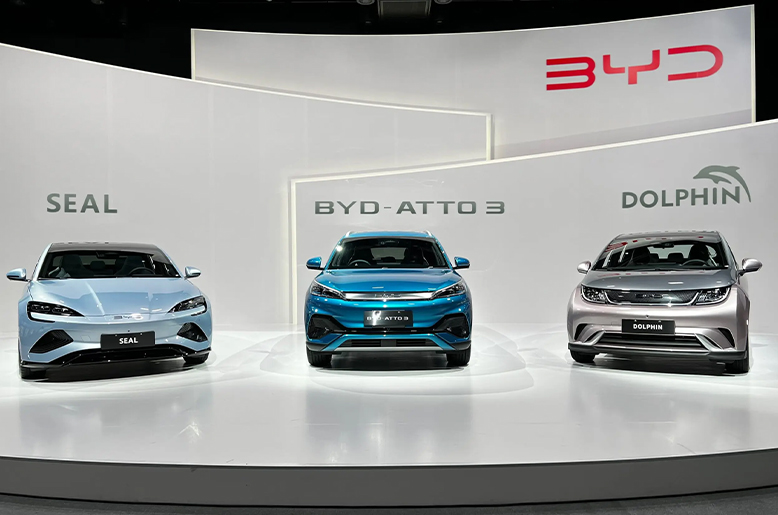
Hub Power Company (HUBCO) plans to bring its BYD vehicle assembly plant online by the end of 2026, with an initial sales target of up to 1,500 vehicles a month as production gathers pace.
According to research by Arif Habib Limited (AHL), shared after the company’s annual general meeting, HUBCO intends to introduce more BYD models in stages, focusing on vehicles that have the strongest sales potential in Pakistan.
The company wants to avoid flooding the market with models that may struggle to find buyers. Instead, management believes competitive prices and product quality will be key to winning customers, AHL said in its report on Tuesday.
The plant’s initial production will depend entirely on imported raw materials and components. However, HUBCO plans to increase local sourcing over time, with a long-term target of localising up to 80 percent of each vehicle.
Higher local content could help lower production costs, improve pricing and reduce the company’s dependence on imported components.
HUBCO’s management also rejected suggestions that the project had been delayed, reiterating its plan to bring the facility online by the end of the calendar year.
The plant is expected to become operational within four to five weeks, Zayan Babar Khan, an analyst at AHL, told Business Recorder.
The development marks a significant step in HUBCO’s push into Pakistan’s automotive sector through its partnership with Chinese electric vehicle maker BYD.
Earlier this month, Liu Xueliang, BYD’s vice president and general manager of its Asia Pacific Auto Sales Division, told BR Research in an exclusive interview that the company’s manufacturing facility in Pakistan was nearing launch in the second half of 2026.
The plant will be BYD’s sixth manufacturing facility outside China, with an initial annual production capacity of 25,000 vehicles. The capacity could later be expanded to 50,000 units a year, Liu said.
Beyond vehicle production, the project is expected to create more than 1,100 jobs and support industrial development in Pakistan. It could also help avoid an estimated 165,000 tonnes of carbon dioxide emissions by 2034, according to Liu.
For Pakistan’s emerging electric vehicle market, the plant could bring a wider range of locally assembled BYD vehicles. The extent to which local production translates into more affordable prices, however, will depend on the pace of localisation and the company’s pricing strategy.
Read next: BYD announces 50% discount offer for Islamabad, Rawalpindi