
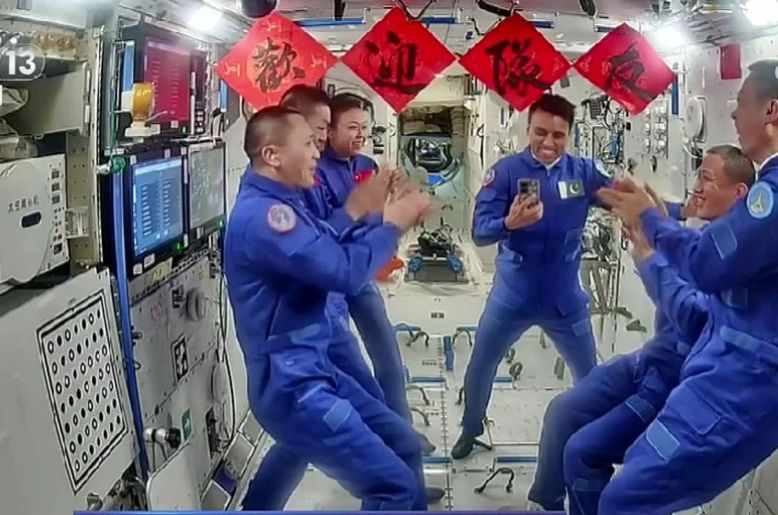
Pakistan achieved a historic milestone on Wednesday as Muhammad Zeeshan Ali became the first Pakistani astronaut to reach space, arriving at China’s Tiangong space station aboard the Shenzhou-24 spacecraft.
The spacecraft successfully docked with the Chinese space station at 8:56am Pakistan Standard Time (PST), approximately three and a half hours after its launch, according to the China Manned Space Agency (CMSA).
The Shenzhou-24 crew, comprising Pakistani astronaut Muhammad Zeeshan Ali and Chinese astronauts Tang Hongbo and Wu Yi, entered the space station, where they received a warm welcome from the Shenzhou-23 crew.
The Long March-2F rocket carrying the spacecraft lifted off from the Jiuquan Satellite Launch Centre in northwestern China at 5:18am PST.
The spacecraft successfully separated from the carrier rocket approximately 10 minutes after liftoff and entered orbit. The CMSA declared the launch a complete success, confirming that all three crew members were in good condition.
Ali has made history not only as the first Pakistani to travel into space but also as the first foreign astronaut to visit China’s Tiangong space station, opening a new chapter in Pakistan-China scientific and technological cooperation.
Scientific experiments aboard Tiangong
Serving as a payload specialist, Ali is expected to spend approximately one week aboard the space station, where he will conduct scientific experiments under the Pakistan-China space research programme.
His responsibilities include installing experimental samples and research equipment and conducting scheduled scientific experiments.
The mission involves four Pakistani biotechnology experiments selected by Chinese institutions from more than 300 research proposals submitted to the Space and Upper Atmosphere Research Commission (SUPARCO) by universities across Pakistan.
The research focuses on areas related to food security and climate change.
The historic mission follows an agreement signed between Pakistan and China in February 2025 to facilitate the selection and training of Pakistani astronauts for missions to the Chinese space station.
Following three rounds of screening and assessment, Muhammad Zeeshan Ali and Khurram Dawood were selected as astronaut candidates and underwent specialised training in China. Ali was subsequently confirmed for the mission, while Dawood was designated as his backup.
A historic moment for Pakistan
Before boarding the spacecraft, Ali saluted the nation and expressed pride in representing Pakistan on the international stage.
“This journey into space is an honour not only for me but for the entire country. I am carrying the dreams of the Pakistani people into space,” he said during a pre-launch press briefing.
A farewell ceremony was also held at the launch centre, attended by Pakistani and Chinese officials, including Federal Minister for Planning, Development and Special Initiatives Ahsan Iqbal.
Iqbal described the mission as a moment of immense national pride and expressed hope that the achievement would inspire young Pakistanis to pursue careers in space science and technology.
“This is just the beginning, not the end,” he remarked.
President, prime minister congratulate nation
President Asif Ali Zardari congratulated the nation on the historic achievement, describing Pakistan’s participation in the Shenzhou-24 mission as a landmark development and a moment of immense national pride.
He expressed hope that the mission would open new horizons for Pakistan’s space programme and contribute to scientific research, innovation and knowledge.
Prime Minister Shehbaz Sharif also described the achievement as a historic moment belonging to every Pakistani.
In a post on X, the prime minister paid tribute to SUPARCO, academic institutions, scientists, the armed forces and other national institutions for their contributions to the mission.
He also thanked Chinese President Xi Jinping for his commitment to strengthening Pakistan-China friendship and expanding bilateral cooperation.
“Pakistan-China friendship is surpassing the heights of the Himalayas, in its journey to outer space,” the prime minister wrote.
The mission marks the first joint crewed spaceflight involving Chinese and foreign astronauts under China’s human spaceflight programme.
Pakistan and China have maintained space cooperation since the early 1990s, with Beijing launching several Pakistani satellites over the decades. The partnership is expected to expand further into lunar exploration, with a Pakistani-built rover scheduled to participate in a Chinese lunar mission around 2028.
The successful arrival of Pakistan’s first astronaut at Tiangong marks a defining moment in the country’s scientific history, paving the way for greater participation in human spaceflight and international space research.