Leading strategists, military experts, diplomats and academics on Monday warned that strategic stability in South Asia was becoming increasingly fragile amid rapid technological changes, disinformation campaigns, unresolved disputes and what they described as India’s attempts to normalise limited warfare under a nuclear overhang.
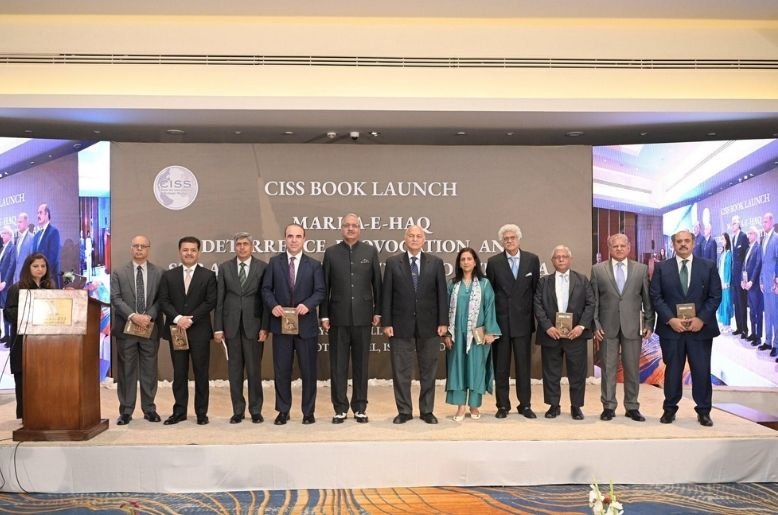
The remarks were made at a ceremony hosted by the Centre for International Strategic Studies (CISS), Islamabad, during the launch of the book Marka-e-Haq: Deterrence, Provocation, and Strategic Maturity in South Asia, marking the first anniversary of Operation Bunyan-um-Marsoos as part of Marka-e-Haq.
The publication brings together contributions from prominent scholars, diplomats and retired military officials, examining deterrence stability, crisis management, regional security dynamics and evolving strategic doctrines in South Asia. Organisers described the book as a timely scholarly effort aimed at analysing the challenges arising from Indian aggression, escalating military posturing and shifting regional security dynamics.
In his opening remarks, Ambassador Ali Sarwar Naqvi, Executive Director of CISS, said South Asia’s strategic environment had become increasingly volatile due to India’s bellicose posture and aggressive strategic signalling. He emphasised the importance of responsible statecraft, sustained dialogue and credible deterrence for preserving regional peace.
Introducing the book, editor Dr Zafar Khan, Executive Director of the Balochistan Think Tank Network, said the publication sought to document evolving patterns of coercion, deterrence and crisis behaviour in South Asia. He noted that the book highlighted Pakistan’s strategic restraint while examining risks stemming from India’s unilateral actions and disinformation warfare.
Delivering the keynote address, General Zubair Mahmood Hayat (Retd), former Chairman Joint Chiefs of Staff Committee, underscored the importance of strategic maturity and institutional preparedness in maintaining deterrence stability. He observed that future conflicts would increasingly involve hybrid warfare, cyber capabilities and narrative manipulation alongside conventional military means.
Other contributors to the book also shared their perspectives on emerging regional security challenges.
Ambassador Zamir Akram (Retd), Advisor to the Strategic Plans Division (SPD), argued that India’s evolving strategic posture had intensified regional insecurity and undermined long-term stability. He said growing militarisation and the absence of meaningful dialogue continued to deepen mistrust between the two nuclear-armed neighbours.
Dr Zafar Nawaz Jaspal, Vice Chancellor of Quaid-i-Azam University, warned that state-sponsored destabilisation and covert operations posed serious threats to regional peace and called for stronger international mechanisms to counter cross-border terrorism and hybrid warfare.
Dr Rizwana Abbasi, Professor at National University of Modern Languages, highlighted the connection between unresolved political disputes and emerging resource insecurities. She cautioned that the weaponisation of water and continued tensions over Kashmir could heighten nuclear risks in the region.
Lieutenant General Mazhar Jamil (Retd), Advisor Development at the National Command Authority (NCA), said India’s evolving offensive doctrines required Pakistan to maintain a calibrated and cohesive deterrence posture while avoiding escalation.
Brigadier Dr Zahir Kazmi (Retd), Arms Control Advisor at SPD, observed that modern deterrence extended beyond conventional military capabilities, encompassing strategic communication, political resolve and cognitive resilience.
Brigadier Dr Naeem Salik (Retd), Executive Director of the Strategic Vision Institute, warned that future crises in South Asia could escalate rapidly because of compressed decision-making timelines and technological advancements. He stressed the need for effective crisis management mechanisms and sustained diplomatic engagement.
Lieutenant General Khalid Ahmed Kidwai (Retd), Advisor to the National Command Authority (NCA), said recent developments had exposed both the strengths and vulnerabilities of deterrence stability in the region, emphasising the importance of responsible nuclear stewardship and strategic restraint.
Lieutenant General Sarfraz Sattar (Retd), Advisor Development to the NCA, said regional crises underscored the importance of understanding adversarial strategic behaviour and maintaining credible deterrence through coordinated political and military signalling.
In his concluding keynote address, Senator Mushahid Hussain Sayed, Chairman of the Pakistan-China Institute, emphasised the importance of intellectual discourse, regional engagement and strategic prudence in addressing emerging security challenges. He noted that think tanks and academic institutions had a critical role in fostering informed debate and policy-oriented research on South Asian stability.
The event was attended by diplomats, academics, researchers, students, senior civil and military officials and foreign diplomats who engaged in discussions on the evolving regional security environment and the future of deterrence stability in South Asia.