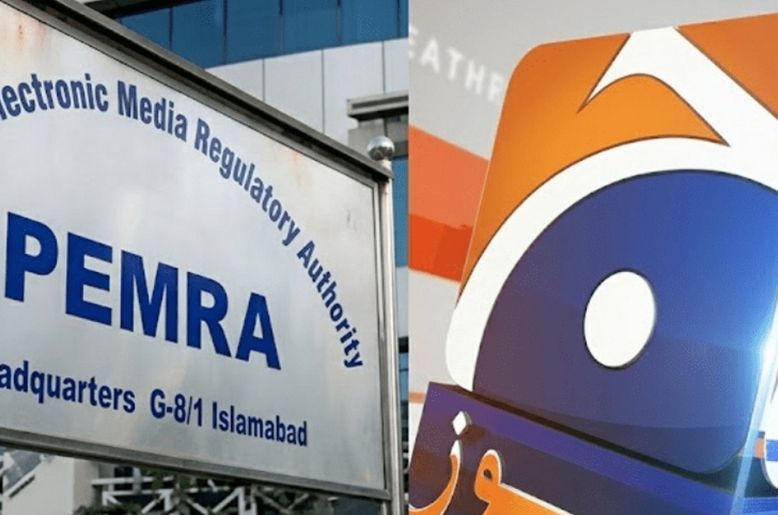
Geo News has informed the Pakistan Electronic Media Regulatory Authority (PEMRA) Council of Complaints on Tuesday that the individuals responsible for producing and approving a sensitive documentary have been dismissed from their jobs.
During a hearing before the Council of Complaints regarding the suspension of Geo News, Supreme Court lawyer Saim Hashmi, who was representing the channel’s license holder company, admitted the mistake on behalf of the management. He also offered an unconditional apology.
Saim Hashmi and High Court lawyer Arbaz Khan also submitted relevant documents to the council representing Geo News.
The documents stated that after an immediate internal inquiry, the management removed the employee who produced the documentary as well as the member of the editorial committee who approved it.
Hashmi also told the council that, to reduce the chances of such incidents in the future, Geo News has decided to include an Islamic scholar in its editorial committee.
The scholar will review sensitive religious content before it is aired and will also help to prevent similar mistakes.
The case relates to a one hour religious travel documentary that was broadcast on the 10th of Muharram 2026.
According to Geo News, the documentary mistakenly included 13 seconds of sensitive footage.
The channel said that it stopped rebroadcasting the documentary before receiving PEMRA’s notification. It added that it also removed the content from its digital platforms.
Geo News temporarily suspends YouTube transmission
Before this, Geo News temporarily suspended its live broadcast on YouTube to comply with PEMRA orders.
Earlier, PEMRA announced the suspension of Geo News’ licence and transmission for 15 days over this documentary.
Following the decision, Geo News admitted that an editorial mistake had been made during the broadcast of its 10th Muharram programme, “Safar-e-Ishq.”
The channel said the footage did not reflect its editorial policy or its commitment to respecting the widely accepted beliefs and religious sensitivities of the Muslim Ummah.
In a statement, the broadcaster said the “programme had depicted certain rituals practised by a limited number of people in Iraq and some other Middle Eastern countries. It clarified that the footage merely portrayed local customs and was never intended to represent, endorse, or promote any broader religious viewpoint.”