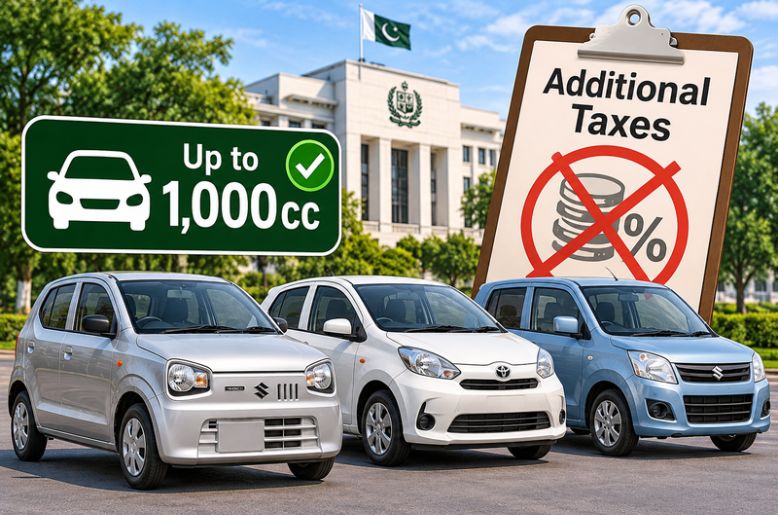
The federal government has announced key features of its proposed Auto Policy 2026, including a commitment not to impose additional taxes on cars with engine capacities of up to 1,000cc.
Prime Minister’s Adviser on Industries and Production Haroon Akhtar Khan said the decision was aimed at providing relief to middle- and lower-middle-income families, who largely depend on smaller vehicles.
He said the policy had been prepared on the prime minister’s instructions and would focus on consumer protection, local manufacturing, export growth and improving vehicle quality to international standards.
Under the new policy, the government plans to increase the financing limit for electric vehicles (EVs) from Rs3 million to Rs10 million.
The repayment period will also be extended from three to five years, allowing buyers more time to repay their loans.
The move is intended to make electric vehicles more accessible to consumers and encourage their adoption in Pakistan.
The government also plans to introduce 45 additional vehicle safety standards under the United Nations WP.29 framework.
According to Haroon Akhtar, the measures will bring vehicle safety and quality requirements in Pakistan closer to international standards.
The new requirements will apply to both locally manufactured and imported vehicles, strengthening safety regulations across the automobile industry.
The proposed policy also includes measures to protect consumers and improve transparency in the automobile market.
Under the new rules, car manufacturers will not be allowed to collect advance booking payments exceeding 20% of a vehicle’s total price.
The government will also introduce third-party audits every six months to monitor compliance and improve accountability within the industry.
The Auto Policy 2026 aims to strengthen Pakistan’s automobile industry by encouraging local production, improving manufacturing standards and increasing exports.
The proposed measures also seek to address consumer concerns over vehicle prices, quality and booking practices.
The government’s announced measures are expected to shape the next phase of Pakistan’s automobile industry, although their implementation will depend on the final policy notification and regulatory framework.