
Fourteen newborn babies died in the fire that swept through the Mother and Child Hospital at the Pakistan Institute of Medical Sciences in Islamabad on August 26.
The cause is being investigated. The prime minister has ordered a high-level inquiry and administrative action has already followed. Until that process is completed, responsibility should not be prejudged.
But one lesson does not require an inquiry.
Hospitals cannot be governed like ordinary government offices. An administrative failure elsewhere may result in a delayed file, an avoidable expenditure or a poor decision. In a hospital, failures of procurement, maintenance, staffing, medicine controls, emergency preparedness or institutional oversight can have irreversible consequences.
PIMS should therefore concern governments well beyond Islamabad.
For Khyber Pakhtunkhwa, the warning is particularly relevant because the province does not lack warning signs. Official inquiries and accountability proceedings have already raised serious questions about recruitment, procurement, medicines, inventory controls, hospital information systems and financial management.
The larger question is no longer whether problems have been identified.
It is what happened after they were identified.
The unfinished trail at MTI D.I. Khan
The affairs of the Medical Teaching Institution in Dera Ismail Khan came under official scrutiny several years ago.
In December 2020, The News reported that NAB Khyber Pakhtunkhwa had converted complaint verification relating to alleged irregularities at the institution into a formal inquiry. The matters under examination included procurement of biomedical equipment, medicines and Covid-related supplies, as well as financial transactions for which supporting records were reportedly unavailable.
In June 2021, Dawn reported that the Health Department had removed Muhammad Arshad Khan Ustrana as chairman of the MTI Board of Governors and dissolved the Board. The report referred to controversies surrounding appointments and the floating of tenders for medicines and equipment. NAB had by then taken notice and obtained official records.
Those reports represented allegations and proceedings at the time.
A later official document is more consequential.
An NAB Khyber Pakhtunkhwa communication dated June 20, 2024, addressed to the Chief Secretary, with attention to the Health Department, dealt specifically with an inquiry into illegal appointments through alleged misuse of authority at MTI D.I. Khan.
The significance lies in its language. The letter states that the “inquiry proceedings established” a series of irregularities.
These included appointments to senior management positions through Board meetings stated to have been held without the required quorum. It also recorded recruitment through a committee which the inquiry considered inconsistent with the applicable MTI framework.
According to the NAB communication, 303 appointments across several categories were made through that committee. It separately recorded 53 Class-IV appointments in excess of sanctioned strength, another 20 without advertisement or recourse to the employment exchange, and a number of faculty appointments and promotions approved through meetings whose quorum was questioned.
These were findings recorded in an official accountability communication. They should not, however, be confused with criminal convictions or judicial determinations against any individual.
The distinction matters.
So does what happened next.
The matter was referred, not simply put away
Based on the inquiry findings and the recommendations of its Regional and Executive Boards, NAB referred the matter to the Government of Khyber Pakhtunkhwa, through the Chief Secretary and Health Department, for departmental corrective action.
It also sought a report on that corrective action within two months.
Following that referral, the inquiry was treated as closed at NAB’s end.
The sequence is important.
The communication does not merely say that a complaint was examined and closed for want of substance. It first records what the inquiry proceedings had established and then transfers the matter to the provincial government for appropriate corrective action.
The accountability responsibility therefore shifted.
What happened after the referral?
Was the report sought within two months submitted? Were the appointments reviewed? Was departmental responsibility examined? Were any appointments cancelled, regularised or otherwise dealt with under the law? Did the Health Department disagree with any of NAB’s findings? If so, where is the reasoned decision?
These are not questions requiring another multi-year inquiry. They are questions of official record.
June 2024 was more than two years ago.
The provincial government should be able to answer them.
Public responsibility returned
The question assumes greater importance because Mr Ustrana subsequently returned to public-sector governance.
He is a member of the Board of Directors of the Khyber Pakhtunkhwa Economic Zones Development and Management Company. In January 2026, APP identified him as chairman of KPEZDMC’s Board Legal Committee, presiding over a meeting dealing with pending litigation and regulatory compliance.
Subsequent Board records also show him continuing to hold significant committee responsibilities within the company.
There is nothing inherently unlawful in such appointments. Nor should an earlier inquiry permanently exclude someone from public responsibility if the matters concerning him have subsequently been examined and resolved.
But that is precisely why the missing part of the record matters.
Was Mr Ustrana subsequently exonerated? Were the findings referred by NAB examined and rejected by the competent authority? Was corrective action completed? Or did the departmental process simply remain unfinished?
If he was formally cleared, the government should disclose the decision. That would be fair to him as much as to the public.
If corrective measures were taken, those too should be placed on record.
If neither happened, the government should explain how an unresolved accountability process was treated when subsequent positions of public responsibility were assigned.
The issue is not presumption of guilt.
It is whether the government’s own accountability process was ever completed.
KTH raises more recent questions
The concerns are not confined to Dera Ismail Khan.
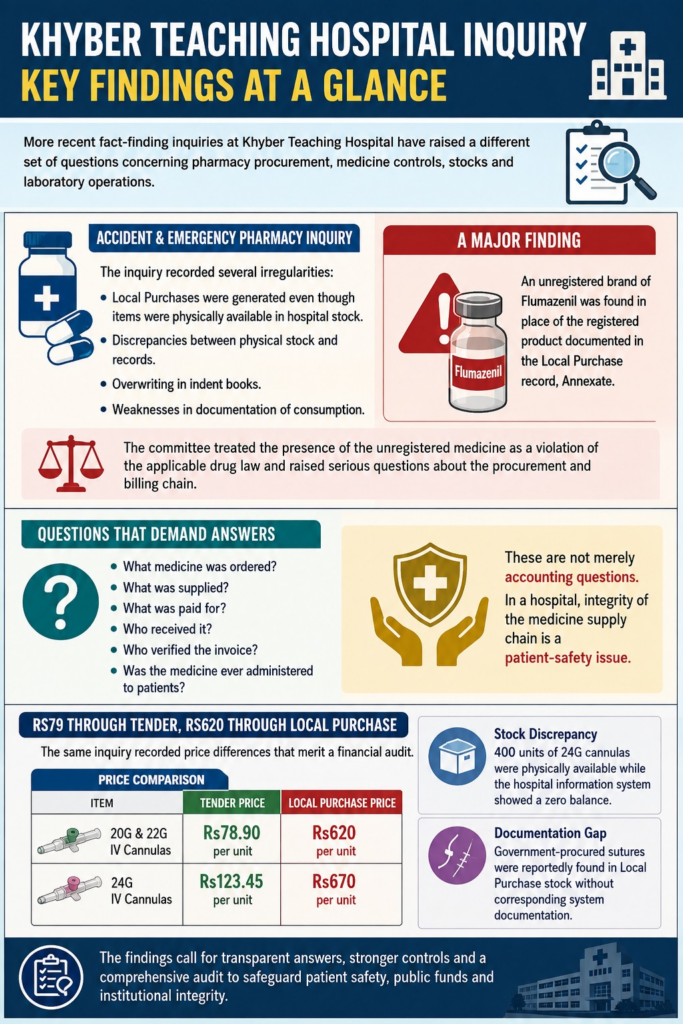
More recent fact-finding inquiries at Khyber Teaching Hospital have raised a different set of questions concerning pharmacy procurement, medicine controls, stocks and laboratory operations.
An inquiry into the Accident and Emergency Pharmacy recorded instances where Local Purchases were generated even though items were physically available in hospital stock. It identified discrepancies between physical stock and records, overwriting in indent books and weaknesses in documentation of consumption.
One finding deserves particular attention.
The committee recorded that an unregistered brand of Flumazenil was found in place of the registered product documented in the Local Purchase record, Annexate.
The committee treated the presence of the unregistered medicine as a violation of the applicable drug law and raised serious questions about the procurement and billing chain.
Again, an internal inquiry is not a final adjudication of misconduct.
But the finding demands straightforward answers.
What medicine was ordered? What was supplied? What was paid for? Who received it? Who verified the invoice? And was the medicine ever administered to patients?
These are not merely accounting questions.
In a hospital, integrity of the medicine supply chain is a patient-safety issue.
Rs79 through tender, Rs620 through Local Purchase
The same inquiry recorded price differences that merit a financial audit.
For certain 20G and 22G IV cannulas, it recorded a tender price of approximately Rs78.90 per unit against a Local Purchase price of around Rs620. For 24G cannulas, the figures recorded were approximately Rs123.45 through tender and Rs670 through Local Purchase.
It also found 400 units of 24G cannulas physically available while the hospital information system showed a zero balance. Government-procured sutures were reportedly found in Local Purchase stock without corresponding system documentation.
There may be explanations for emergency Local Purchase. The committee itself referred to delayed supplier payments as one factor.
But that raises further questions.
Who delayed the payments? For how long? How much material was consequently purchased at substantially higher prices? What was the resulting financial impact? And why did physical stock and electronic records not reconcile?
These figures can be audited. They should be.
The inquiry also referred to suspicious activity after the investigation commenced, including what it described as “cover-up operations”, with references to CCTV footage and pharmacy records.
If that evidence was preserved and subsequently examined, the findings should be available.
If it was not, that is itself a governance concern.
A laboratory gap of more than 135,000 tests
A separate KTH inquiry into laboratory operations raised another serious issue.
It identified a difference of approximately 135,000 between laboratory tests performed and tests against which invoices had been generated. Around 930,000 tests were examined against approximately 795,000 invoiced items.
The committee also identified weaknesses in computer access, patient categorisation, work orders, reconciliation between physical activity and hospital information systems, machine integration and audit controls.
Then came a figure that deserves explanation.
After scrutiny began, laboratory revenue for July 2025 reportedly rose to approximately Rs12.2 million, compared with an average of around Rs5.3 million over the preceding six months.
That increase does not establish theft or deliberate revenue leakage. The committee did not reach such a conclusion, and neither should anyone else without evidence.
But a revenue increase of more than 100 per cent following the commencement of scrutiny plainly requires examination.
The inquiry itself acknowledged failures and omissions but said limitations in the available record prevented responsibility for deliberate acts from being fixed. It recommended deeper examination, including third-party scrutiny of database logs.
Was that forensic examination conducted?
If not, why not?
The real weakness is what happens after an inquiry
MTI D.I. Khan and Khyber Teaching Hospital involve different institutions, different periods and different individuals. They should not be merged into a single allegation.
What connects them is institutional.
Pakistan’s public sector is not short of inquiries. Committees are formed, statements are recorded, reports are written and recommendations are made.
The weakness often appears afterwards.
Who follows the recommendation? Who reconciles the accounts? Who reviews an irregular appointment? Who recovers a loss if one is established? Who fixes responsibility? Who corrects the system? And who reports back to the authority that ordered the inquiry?
Without that final stage, accountability becomes an exercise in documentation rather than correction.
In healthcare, that is particularly dangerous.
Weak stock controls can leave medicines unavailable when they are needed. Poor procurement controls can allow questionable products into a hospital. Weak digital systems can conceal inventory or revenue discrepancies. Poor recruitment and governance can place people in sensitive positions without adequate scrutiny. Neglected infrastructure and safety systems can transform an equipment failure into catastrophe.
Not every irregularity leads to loss of life.
But safe hospitals are built by correcting weaknesses before several failures converge.
PIMS has changed the urgency
This is where the PIMS tragedy must change the conversation.
Fourteen newborn babies are dead. A high-level inquiry may determine exactly how the fire started, whether safety systems failed and where responsibility lies. But no finding can restore those children to their families.
Khyber Pakhtunkhwa should not require a similar tragedy before acting on weaknesses already identified in its own hospitals.
There is enough on record to begin immediately.
The Chief Secretary should require the Health Department to place before him the complete status of NAB’s June 2024 referral concerning MTI D.I. Khan, including the corrective-action report that was sought within two months.
The government should clarify whether the recorded findings were acted upon, rejected, regularised or otherwise resolved. Where individuals were cleared, that should be stated. Where responsibility was established, the action taken should be disclosed.
At KTH, the provincial government should establish the present status of both inquiries. The medicine procurement findings, Local Purchase price differences, stock discrepancies, reported interference with records and the laboratory billing gap should either be explained or taken forward for independent forensic examination.
And there is a broader requirement that should no longer wait.
Every major public hospital and MTI in the province should now be subjected to an urgent review of fire safety, electrical systems, oxygen infrastructure, emergency exits, critical equipment maintenance and evacuation arrangements. Serious weaknesses identified through previous audits and inquiries should be placed on a time-bound compliance dashboard under the Health Department and Chief Secretary’s Office.
This is not a case for another layer of committees.
It is a case for completing the work that existing committees and inquiries have already begun.
The window for routine administrative handling has narrowed considerably after PIMS.
Warnings that remain buried in files cease to be warnings in any meaningful sense. They become evidence that the system knew of risks but did not act decisively enough.
No government can eliminate every accident. But once weaknesses have been documented, failure to address them becomes increasingly difficult to defend.
Khyber Pakhtunkhwa has been warned by its own inquiries.
The responsible course is to act now, preserve the evidence, complete unfinished accountability proceedings and correct identifiable hospital risks while the issue is still one of governance and prevention.
The province should not wait for another hospital tragedy to discover that the price of delay was measured not in audit objections or unanswered files, but in lives.
Also read: CDA probe blames locked PIMS exits but stays silent on rescue response failures

