
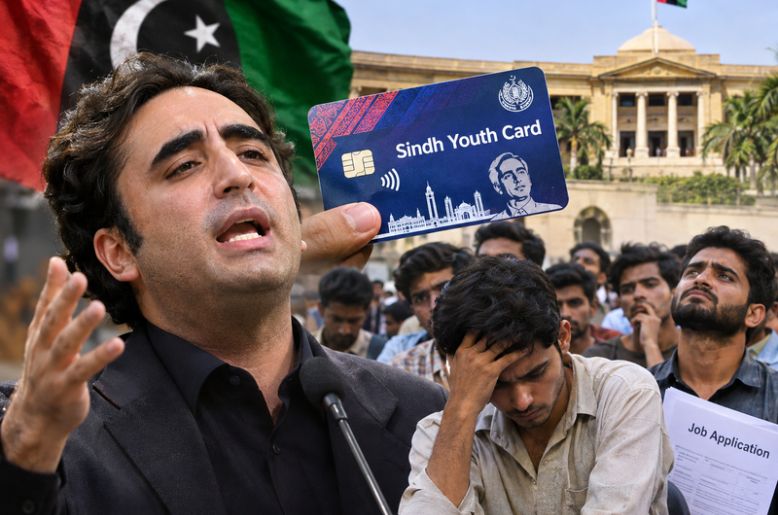
The launch of the “Sindh Youth Card” by the Pakistan Peoples Party (PPP), which has governed Sindh for the past 18 years, and its Chairman Bilawal Bhutto Zardari at the Chief Minister’s House in Karachi on November 23, 2026, has been described by political observers, economic experts and unemployed youth as another “political lollipop” and an attempt to mislead the public.
Analysts argue that during the PPP’s 18-year rule, government jobs were sold through bidding, urban youth were deprived of their rights through fake domiciles, and more than 7.4 million children remained out of school.
They claim that the distribution of Visa debit cards to merely 100,000 young people is another political manoeuvre aimed at diverting attention from the growing public movement for new provinces and pacifying mounting frustration among unemployed youth.
Figures cited from official survey reports, the Pakistan Bureau of Statistics (PBS) Labour Force Survey and educational documents have raised questions over Bilawal’s claim that his party is integrating young people into the mainstream economy.
According to the cited statistics, the unemployment rate among young people aged 15 to 24 across Pakistan has exceeded 12.5 per cent, while unemployment among educated youth in Sindh’s urban areas, particularly Karachi and Hyderabad, has reportedly reached 17 to 18 per cent.
Nearly 60 per cent of Sindh’s population of more than 55 million comprises young people. Millions of them reportedly face severe mental stress and frustration due to limited employment opportunities, industrial closures and deteriorating infrastructure.
Against this backdrop, the announcement to issue Sindh Youth Cards to only 100,000 young people across the province’s 30 districts in the first phase has been described by critics as a mere drop in the ocean.
The PPP’s 18-year performance in the education sector presents an even more troubling picture, according to critics.
Recent government reports and educational surveys indicate that despite the allocation of hundreds of billions of rupees annually, more than 7.4 million children in Sindh remain out of school.
Furthermore, more than 1,459 ghost schools reportedly exist only on paper, while 5,922 government schools lack basic facilities such as clean drinking water, electricity, toilets and boundary walls.
Critics question how a plastic Visa card offering discounts at restaurants and gyms can transform the future of young people in a province where millions of children remain deprived of education and graduates allegedly face discrimination through fake domiciles, nepotism and bribery.
Political and economic observers claim that over the past 18 years, the Sindh government has received more than Rs25 trillion (approximately $145 billion, according to the original account) through the National Finance Commission (NFC) Award, federal grants and royalties from natural resources.
However, they allege that instead of establishing new universities, IT parks, modern vocational training centres and generating employment opportunities, public funds have been lost to financial irregularities and commission mafias.
The account also cites Auditor General reports alleging annual financial irregularities amounting to Rs836 billion.
Critics further allege that the PPP has previously used employment schemes and card-based initiatives to benefit party loyalists and favoured individuals.
They argue that as demands for new administrative units and a referendum gain momentum in Sindh, Bilawal Bhutto Zardari has resorted to an old political tactic by introducing the Youth Card to appease young people.
However, critics maintain that Sindh’s increasingly aware youth are no longer willing to be persuaded by unfulfilled promises and plastic cards, and instead demand genuine employment opportunities, quality education and economic development.