
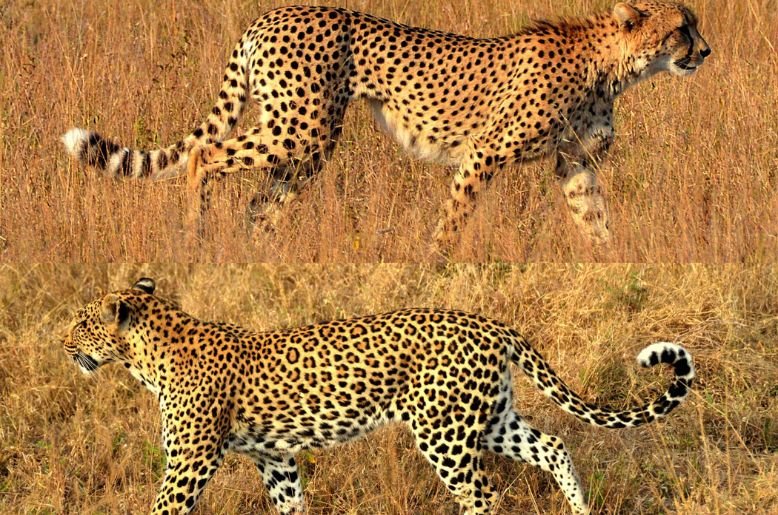
On the vast plains of Africa, two iconic big cats roam. At a glance, the cheetah and the leopard might look similar with their spotted coats. However, these two animals are vastly different. They have unique body shapes, hunting methods, and social behaviors that set them apart. Understanding these differences is key to appreciating each magnificent predator.
This guide will give you a clear comparison of the cheetah vs the leopard. We will look at their physical traits, from their spots to their body build. We will explore how they hunt, what they eat, and where they live. By the end, you will easily be able to tell these two incredible cats apart.
Physical Appearance: More Than Just Spots
The easiest way to distinguish between a cheetah and a leopard is by looking closely at their physical features. Their spots, body shape, and facial markings are all unique.
The Telltale Spots
The most famous feature of both cats is their spotted coat, but the patterns differ. A cheetah has solid black, round or oval-shaped spots. These spots are simple and clearly defined, like polka dots scattered across its coat.
A leopard, on the other hand, has more complex markings called rosettes. These are clusters of black spots that form a rose-like pattern. The rosettes on an African leopard are often square and small, while those on an Asian leopard might be larger and more circular. These patterns provide excellent camouflage in the dappled light of trees and bushes.
Body Shape and Build
The difference in their build comes from their different lifestyles. A cheetah is built for speed. It has a long, slender, and lightweight body with long legs. This streamlined frame makes it the fastest land animal on Earth. Its deep chest houses large lungs and a powerful heart to support its high-speed sprints. A cheetah typically weighs between 77 and 140 pounds.
A leopard is built for power. It has a much more muscular and robust body. Its legs are shorter and stockier, and its head is larger in proportion to its body. This robust build allows leopards to climb trees with ease, even while carrying heavy prey. A leopard is significantly heavier, weighing between 80 and 200 pounds.
Distinctive Facial Markings
You can also tell a cheetah from a leopard by looking at its face. A cheetah has very distinct black lines that run from the inner corner of each eye down to the sides of its mouth. These are called “tear marks.” Scientists believe these lines help reflect sunlight, allowing the cheetah to focus on prey during a hunt in bright daylight.
A leopard does not have these tear marks. Its face is covered in smaller spots and rosettes, but it lacks the prominent black lines seen on a cheetah. This is a reliable and straightforward way to identify them in the cheetah vs leopard comparison.
Speed and Movement: Sprinters vs. Stalkers
The way these two cats move is directly related to their body structure and hunting style. One is a world-class sprinter, while the other is a silent and powerful stalker.
Don’t miss our in-depth article on A Complete Comparison of Dire Wolf vs Gray Wolf.
The Cheetah: A Burst of Speed
The cheetah is famous for its incredible speed. It can accelerate from 0 to 60 miles per hour in just three seconds. It can reach top speeds of up to 70 miles per hour, but only for short distances of a few hundred yards. Every part of its body is adapted for this explosive speed.
Its flexible spine allows it to stretch and cover a vast amount of ground with each stride. Its long tail acts like a rudder, providing balance and helping it turn sharply while chasing prey. A cheetah’s claws are also unique among big cats. They are semi-retractable, meaning they are always partially out. This gives them extra grip on the ground, similar to the spikes on a sprinter’s shoes.
The Leopard: Stealth and Power
The leopard is not built for long chases. Instead, it relies on stealth, surprise, and raw strength. Leopards are ambush predators. They use their spotted coats to blend into their surroundings, stalking their prey silently until they are close enough to pounce.
Their muscular bodies give them immense power. Leopards are incredible climbers and often rest in trees during the day. They are so strong that they can haul prey heavier than themselves up into a tree. This keeps their meal safe from other predators, such as lions and hyenas. Leopards are also skilled swimmers and are comfortable in the water.
Hunting and Diet: Different Strategies
The cheetah vs leopard debate continues when we look at their hunting habits and diet. Their physical abilities dictate what they hunt and how they catch it.
Cheetah’s Hunting Style
Cheetahs are diurnal hunters, meaning they hunt primarily during the day, usually in the early morning or late afternoon. This helps them avoid competition with larger, nocturnal predators such as lions and leopards. A cheetah uses its keen eyesight to spot prey from a distance. It then stalks its target before launching into a high-speed chase.
Their diet consists mainly of smaller- to medium-sized animals. They often hunt gazelles, impalas, springboks, and young wildebeest. After a successful hunt, a cheetah must eat quickly. It is usually exhausted from the chase and is vulnerable to having its kill stolen by stronger predators.
Leopard’s Hunting Style
Leopards are primarily nocturnal hunters. They use the cover of darkness to their advantage. A leopard will patiently and silently stalk its prey, getting as close as possible before launching a sudden, powerful attack. Their strategy is based on surprise rather than speed.
Leopards are opportunistic and have a very broad diet. They will eat almost anything they can catch, from insects and rodents to large antelopes. Their diet also includes birds, reptiles, and fish. This adaptability allows them to thrive in a wide range of habitats. Their ability to carry prey into trees is a key survival tactic.
Habitat and Social Structure
The final pieces of the cheetah vs leopard puzzle are where they live and how they interact with each other.
Cheetah’s Social Life and Habitat
Cheetahs prefer open grasslands, savannas, and scrublands. These open spaces provide them with room to use their incredible speed during a hunt. They are generally more social than leopards. Females are usually solitary or live with their cubs. Male cheetahs, however, often form small groups called coalitions, which are typically made up of brothers. These coalitions work together to defend their territory and hunt.
Leopard’s Solitary Existence
Leopards are highly adaptable and can be found in a broader range of habitats than cheetahs. They live in rainforests, woodlands, savannas, mountains, and even near urban areas. They are masters of survival.
Leopards are solitary animals. They live and hunt alone, only coming together to mate. A leopard will mark its territory with urine and claw marks to warn other leopards to stay away. Their elusive, solitary nature makes them much more challenging to spot in the wild than cheetahs.
Frequently Asked Questions
1. What is the main difference between a cheetah and a leopard?
The main difference is their spots. Cheetahs have solid black spots, while leopards have rosette patterns. Cheetahs also have black “tear marks” on their faces, unlike leopards.
2. Which is bigger, a cheetah or a leopard?
A leopard is bigger and more muscular. It is built for strength and climbing, while a cheetah has a slender, lightweight body built for speed.
3. Who would win in a fight, a cheetah or a leopard?
A leopard would likely win in a fight. It is stronger, heavier, and more aggressive than a cheetah. Cheetahs typically avoid confrontation.
4. Do cheetahs and leopards live in the same areas?
Yes, their habitats can overlap in parts of Africa. However, leopards are more adaptable and live in the broader variety of environments, including forests and mountains.
5. Are cheetahs a type of leopard?
No, they are two different species from separate branches of the cat family tree. Cheetahs belong to the genus Acinonyx, while leopards belong to the genus Panthera.


