
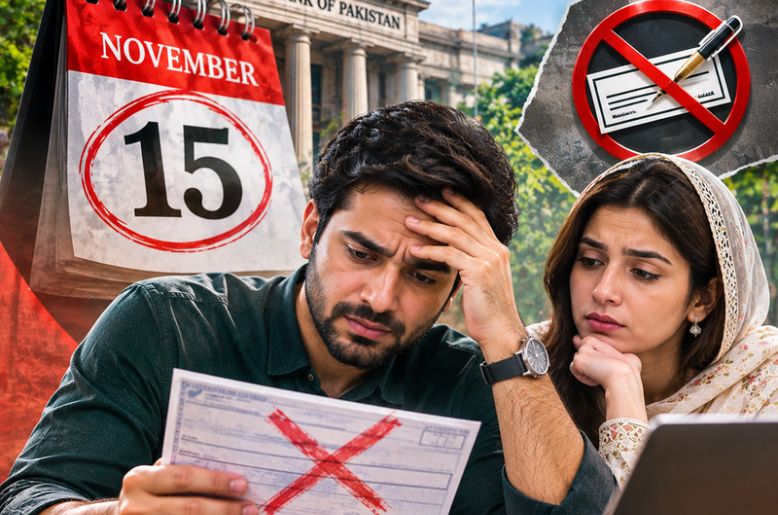
The federal government has announced that cheque payments in Pakistan under the Asaan Assignment Accounts (AAA) system will be discontinued from November 15, as part of its efforts to shift government transactions to digital payment channels and promote a cashless economy.
Under the new arrangement, all payments through Asaan Assignment Accounts will be processed exclusively through the State Bank of Pakistan’s (SBP) Raast digital payment system from November 16.
The decision was announced during a high-level meeting on promoting a cashless economy, chaired by Prime Minister Shehbaz Sharif on Friday.
Officials informed the meeting that drawing and disbursing officers (DDOs) responsible for handling government payments had already received training to implement the new digital payment system.
The government is also accelerating the digitisation of financial transactions across federal and provincial departments, with most institutions expected to complete the transition by December 2026.
Cheque payments Pakistan: What changes from November 15?
The discontinuation of cheque-based transactions under the AAA system means that government payments covered by the arrangement will no longer be processed through traditional cheques.
Instead, the government will use Raast, Pakistan’s instant digital payment system, to process transactions from November 16.
The move is part of a broader government initiative to reduce reliance on cash and paper-based transactions while improving transparency and efficiency in public-sector payments.
Officials also informed the meeting that all payments under the Benazir Income Support Programme (BISP) were already being made through digital wallets.
Government sets December 2026 deadline for digital payments
During the meeting, the prime minister directed relevant ministries and government departments to establish clear targets and deadlines for expanding digital payment services.
He stressed that technical difficulties, consumer-related issues and inadequate internet connectivity must be addressed to ensure the successful implementation of the cashless economy initiative.
Shehbaz Sharif also called for greater public awareness of digital payment options and directed authorities to promote Raast QR code transactions between consumers and merchants.
He urged the relevant departments to launch an effective media campaign encouraging electricity and gas consumers to pay their utility bills by scanning QR codes printed on their bills.
Digital payments to expand to areas without internet
Officials briefed the meeting that work was under way to introduce a system allowing digital transactions in areas without internet connectivity.
Efforts were also being accelerated to develop the infrastructure required to improve internet access across the country.
The prime minister said wider access to technology and reliable internet services was essential to making digital payments accessible to all sections of society.
He described the transition towards digital transactions as a key government priority and commended the finance ministry and other relevant institutions for their efforts to promote a cashless economy.
The meeting was attended by Finance Minister Muhammad Aurangzeb, IT Minister Shaza Fatima, Information Minister Attaullah Tarar, Minister for Maritime Affairs Junaid Anwar Chaudhry, Petroleum Minister Ali Pervaiz Malik, Power Minister Awais Leghari, Adviser to the Prime Minister on Political Affairs Rana Sanaullah, Minister of State for Finance Bilal Kayani, State Bank Governor Jameel Ahmad, provincial chief secretaries and senior government officials.