
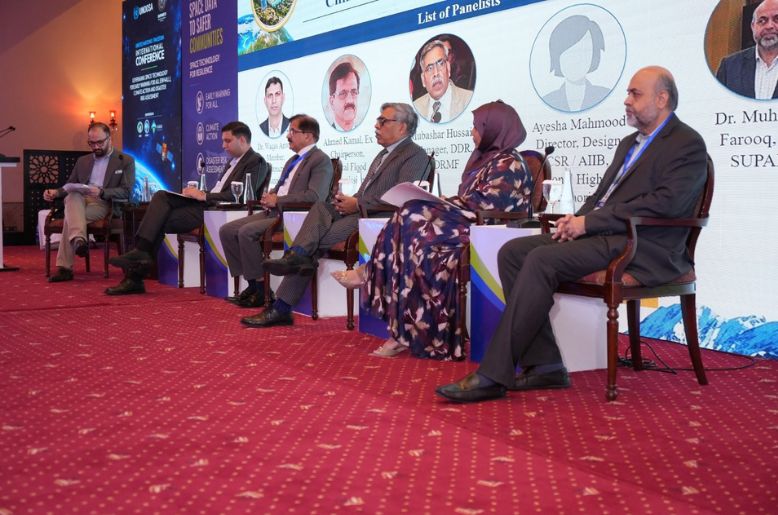
The third day of the UN-Pak International Conference on “Leveraging Space Technology for Early Warning for All (EW4All), Climate Action and Disaster Risk Assessment” focused on “Space for Climate Action & Resilient Development.”
The proceedings featured three technical sessions and two panel discussions, bringing together experts from Pakistan, China, Tunisia, Thailand, Italy and other participating countries to exchange knowledge on climate intelligence, disaster risk reduction and resilient development.
Technical session on “Space for Climate Action”
During the technical session on “Space for Climate Action,” participants highlighted the growing importance of satellite-based monitoring in tracking carbon emissions, atmospheric aerosols, temperature extremes, forests, groundwater and urban air quality.
Presentations also explored the use of Earth observation technologies in agricultural water management and early warning systems.
Another session on “Climate Risk and Governance” examined geospatial applications in multi-hazard assessment, extreme rainfall analysis, crop monitoring, food security and drought forecasting.
Experts also discussed how space-based climate intelligence can strengthen disaster risk governance, improve financial resilience and support climate adaptation planning under the EW4All initiative.
The two panel discussions “Climate Change Actions: Resilient Infrastructure” and “Climate Risk Financing through Technology-Enabled Hazard Detection and Crop Yield Loss Estimation” focused on the integration of climate risk assessments into infrastructure planning, flood management and disaster risk reduction strategies.
Speakers said these technologies can play a critical role in minimising vulnerabilities to climate-related hazards, improving crop yield loss estimation and supporting stronger insurance and financial decision-making mechanisms.
The discussions also emphasised the need for closer collaboration among scientific institutions, policymakers, development partners and the financial sector to build climate resilience.
The day’s proceedings underscored the increasing role of space technology in enhancing early warning systems, strengthening climate risk governance and promoting resilient development through international cooperation, knowledge sharing and evidence-based decision-making.