
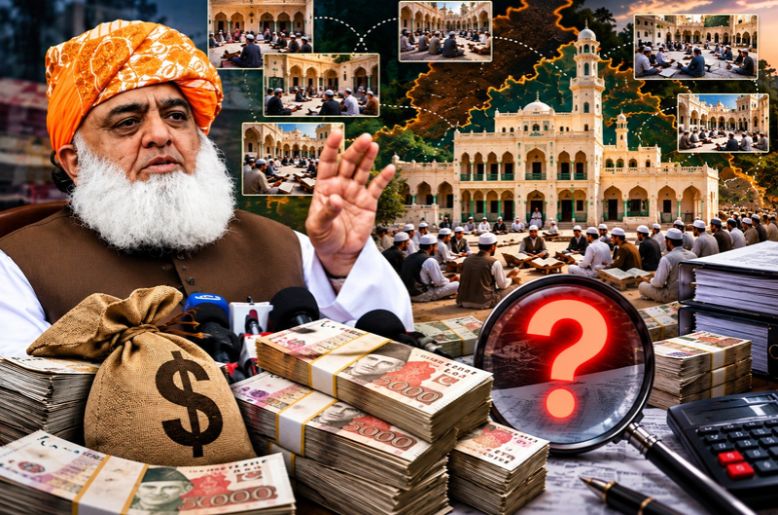
Thousands of unregistered madrassas operating across Pakistan without effective government oversight, billions of rupees in questionable financial flows, and political and ideological indoctrination through these institutions have raised serious concerns about the country’s economy and national security.
Security and economic experts have called for all unregistered madrassas to be brought under government supervision immediately under the National Action Plan (NAP), with their financial records subjected to regular audits. Their demands have gained urgency following revelations about individuals involved in facilitating Fitna al-Khawarij.
Unregistered madrassas and Fazlur Rehman’s network
According to the details received, Pakistan has approximately 40,000 madrassas, of which between 25,000 and 30,000 are under the direct or indirect political or ideological influence of Fazlur Rehman and his party, Jamiat Ulema-e-Islam (JUI-F).
Thousands of these institutions are being directly operated by members of Fazlur Rehman’s family, close religious scholars, and the party’s district and provincial office-bearers. However, many of them have yet to register with any government institution.
Estimates suggest that more than 50 per cent of the country’s madrassas have no formal registration or government licence. This has raised questions about the state’s ability to monitor their educational systems, curricula and ideological activities.
Parallel economy worth over Rs70 billion and lack of transparency
According to a report by the international research organisation International Crisis Group, annual donations, Zakat, Fitrana and funds collected through the sale of sacrificial animal hides during Eidul Azha for these unregistered and politically influential madrassas are estimated to exceed Rs70 billion.
Since the financial affairs and bank accounts of these institutions are not subjected to government audits or effective banking oversight, questions remain about the sources of this enormous funding and how the money is being utilised.
There are also concerns about whether such large cash flows outside the formal banking system could facilitate illegal financial activities or the circulation of black money.
Economic experts say that keeping more than Rs70 billion outside the formal economy raises serious questions about transparency, financial regulation and the country’s banking system.
Indoctrination and political use of children
Sources claim that millions of children studying in these madrassas are kept away from modern scientific and educational disciplines and are subjected to ideological conditioning for specific political objectives.
During political rallies, sit-ins and protest demonstrations, madrassa students are brought onto the streets and used as a source of manpower or street power.
Such practices, if established, would not only jeopardise the children’s future but also raise serious questions about the exploitation of young students for political interests.
Fitna al-Khawarij links and national security concerns
Recent arrests and confessional statements during security operations against Fitna al-Khawarij have reportedly added to concerns about the possible misuse of religious institutions.
During interrogation, a self-proclaimed cleric identified as Zafar Yab, who was involved in facilitating Fitna al-Khawarij, disclosed that he had also received his education from a madrassa associated with Fazlur Rehman.
Following such revelations, security experts have warned that the unchecked operation of unregistered madrassas could pose serious challenges to internal security and public order.
They have stressed the need for immediate government oversight, transparent financial audits and effective regulation of religious educational institutions to prevent their possible exploitation for political or unlawful activities.