
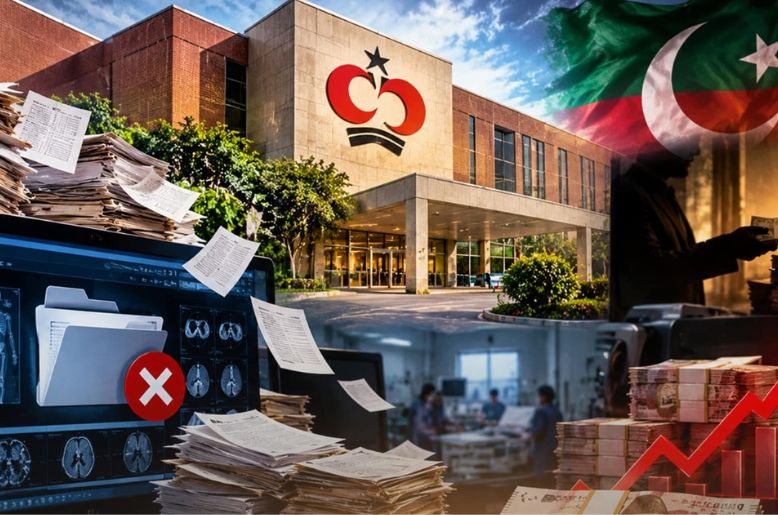
Massive financial irregularities involving laboratory billing software linked to Shaukat Khanum Memorial Cancer Hospital and Research Centre have come to light at Khyber Teaching Hospital (KTH), where records of more than 135,000 medical tests conducted during evening outpatient department (OPD) hours are reportedly missing, resulting in an estimated monthly revenue loss of Rs7 million.
According to an inquiry report got by Azaad Digital, the discrepancy emerged after a professor noticed an unusual decline in pathology laboratory revenue and found that the number of tests recorded in the billing system was significantly lower than the number actually performed. The software is reportedly being used at hospitals operating under the Medical Teaching Institutions (MTI) Act, 2015, in Khyber Pakhtunkhwa, including KTH, Lady Reading Hospital and Hayatabad Medical Complex.
Sources said control of the system rests with the relevant information technology (IT) section, while local hospital staff are not authorised to access or modify its data.
Following complaints about the declining revenue, an inquiry committee was formed under the supervision of the official responsible for institutional practice. The inquiry report found that approximately 930,000 tests had been conducted in the pathology laboratory, while billing records accounted for only 794,000 tests. The discrepancy involved more than 135,000 tests, with the resulting monthly financial loss estimated at Rs7 million.
Sources further claimed that when the committee sought the original records from Shaukat Khanum Hospital, no corresponding entries for the missing tests could be found there either.
Laboratory revenue surges by 130% after inquiry begins
One of the most significant findings highlighted in the report was an abrupt increase of more than 130% in laboratory revenue shortly after the inquiry began.
The sudden rise has raised questions about the laboratory’s previous billing practices, revenue collection and internal monitoring mechanisms. However, it remains unclear whether the increase resulted from improved billing procedures, stricter financial controls or the correction of earlier discrepancies.
The report also identified alleged irregularities in patient categorisation. According to the findings, the categories of around 100 patients were changed daily, with some patients’ records transferred to the morning OPD so their tests could be billed at lower rates.
The report further alleged that additional charges were collected outside the official billing system. The inquiry has yet to establish who authorised these practices or determine their full financial impact.
Hospital director reportedly restricts access to records
The inquiry committee reportedly recommended further investigation and possible legal action to determine the extent of the alleged irregularities. However, according to the report, the hospital director subsequently issued a letter directing the relevant IT section at Shaukat Khanum Hospital not to provide additional records, raising concerns about the inquiry’s progress.
When contacted, a senior KTH official said the software had been provided free of charge and that the hospital had made no payment for it. The official maintained that the handling of hospital records fell within the hospital director’s discretionary authority, describing the matter as a minor IT error and saying that no further investigation was necessary.
An inquiry officer, speaking on condition of anonymity, disputed the suggestion that the matter had been resolved, saying the investigation remained incomplete.
The officer also raised concerns about the possibility of similar discrepancies in the morning OPD, suggesting that a comprehensive examination of billing records across all shifts was necessary to determine the potential scale of the losses.
The officer further warned that sharing patient data with unauthorised individuals or parties could constitute a serious breach of medical confidentiality and professional ethics.
Lack of barcoding system raises concerns over data security
The absence of an effective modern barcoding system has also raised questions about transparency and accountability in laboratory operations. Barcoding systems help link individual patients to their test requests, billing records and laboratory reports, making it easier to trace discrepancies and maintain accurate records.
Weaknesses in these controls can make it difficult to identify errors promptly and may create opportunities for unauthorised changes to patient or billing data. The reported discrepancies have also raised questions about who was responsible for overseeing the software, why the individuals accountable for the missing records have not been identified, and whether the system allows data to be entered, modified or deleted without adequate oversight.
The inquiry’s findings, along with the reported restrictions on access to records, have intensified calls for a transparent and impartial investigation into the alleged financial irregularities.
A comprehensive audit of laboratory tests, billing records, software access logs and revenue collection across all OPD shifts could help establish the extent of the discrepancies, identify any individuals responsible and determine whether further legal action is warranted. The allegations have not been independently verified, and the findings of a completed, impartial investigation would be necessary to establish responsibility and determine the full extent of any financial loss.