
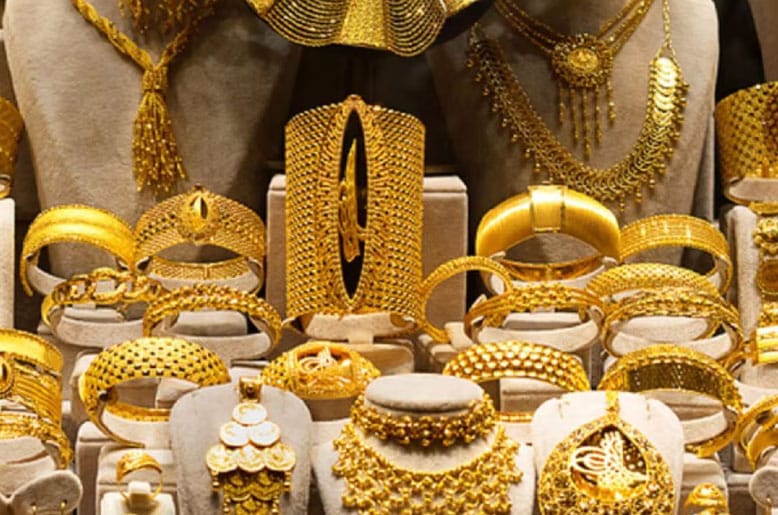
Gold prices moved lower in Pakistan on Monday, reversing the gains recorded over the weekend, as weakness in the international market filtered through to local rates.
According to figures released by the All-Pakistan Gems and Jewellers Sarafa Association (APGJSA), the price of gold per tola dropped by Rs3,100 to settle at Rs471,762.
The decline was also reflected in the 10-gram market, where gold lost Rs2,658 to close at Rs404,459.
The latest drop comes just two days after the precious metal climbed by Rs1,300 per tola on Saturday, when prices had reached Rs476,162.
The international gold market also remained under pressure. The global benchmark price fell by $31 during the day and was reported at $4,494 per ounce, including a $20 premium.
Silver prices, however, showed no change. The metal remained stable at Rs8,034 per tola in the local market.
Global factors weigh on gold
Internationally, gold came under pressure as a stronger US dollar and a rise in crude oil prices reduced demand for the safe-haven asset.
Spot gold slipped 0.7 percent to $4,505.87 per ounce during trading, after touching a two-week high in the previous session. US gold futures for August delivery were also lower, falling 1.2 percent to $4,535.90 per ounce.
A stronger dollar typically makes gold more expensive for buyers using other currencies, which can dampen demand and weigh on prices.
Market sentiment was also influenced by developments in the Middle East. Investors continued to monitor tensions involving the United States, Iran and Israel, while awaiting US President Donald Trump’s decision on a proposal to extend a ceasefire with Iran.
Analysts said rising oil prices added another layer of uncertainty. Crude oil gained more than 3 percent on Monday, raising concerns that inflation could remain elevated and prompt central banks to keep interest rates higher for longer.
Tim Waterer, chief market analyst at KCM Trade, said the combination of firmer oil prices and uncertainty surrounding a potential US-Iran agreement had left gold struggling to find direction at the start of the week.
Gold is often viewed as a hedge against inflation and geopolitical risks. However, higher interest rates can reduce its appeal because the metal does not offer any yield.
Adding to concerns, Federal Reserve Vice Chair Michelle Bowman recently warned that ongoing tensions in the Middle East could contribute to inflationary pressures and potentially require tighter monetary policy.
Despite the latest decline, Waterer said gold could still have room to rise further over the longer term. He noted that lower oil prices, a weaker US dollar, continued central bank purchases and persistent geopolitical risks could help push the metal towards $5,500 per ounce by the end of 2026.
Read next: Gold price in Pakistan falls for second time in a week
