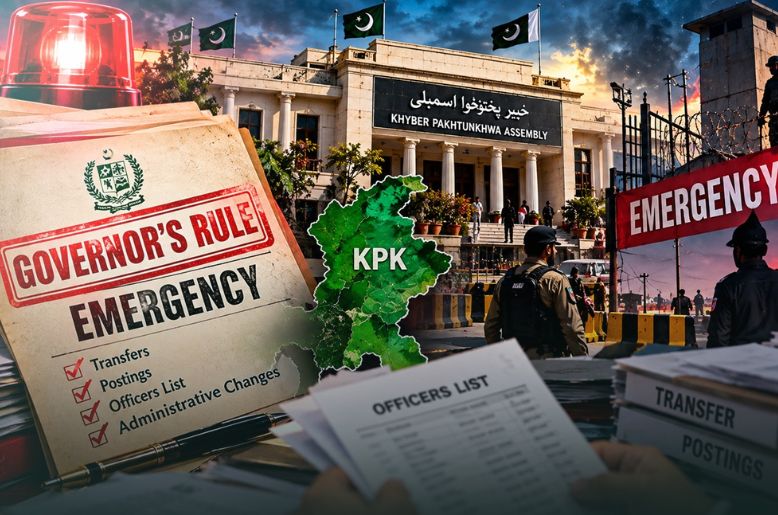
Preparations for a possible governor’s rule or emergency in Khyber Pakhtunkhwa have reportedly been completed, with the federal government reviewing administrative changes and police appointments across the province.
According to sources, preliminary work covering the replacement or appointment of deputy commissioners, secretaries and other administrative officials has been finalised. Lists of potential appointments for regional and district police officer positions have also been prepared.
Sources said a proposal to impose emergency measures initially in 12 districts of Khyber Pakhtunkhwa was also under consideration.
However, the final decision on whether to impose an emergency or governor’s rule will depend on the outcome of contacts between government and opposition representatives.
Governor’s rule in KP linked to negotiations
According to sources, the government will not proceed with emergency measures or governor’s rule if negotiations between the government and opposition succeed.
Although formal negotiations between the two sides are reportedly not taking place, backchannel contacts and confidential communications are continuing.
The situation remains under review as authorities assess the possibility of resolving political differences through dialogue.
PTI leadership to meet Sohail Afridi
Meanwhile, senior Pakistan Tehreek-e-Insaf (PTI) leaders are expected to meet Khyber Pakhtunkhwa Chief Minister Sohail Afridi on Saturday to discuss the latest political developments.
Sources said Barrister Gohar Ali Khan and other party leaders would brief the chief minister on messages received at the federal level.
The meeting is also expected to cover the party’s proposed long march and the next steps in its political strategy.
According to sources, the PTI leadership and the chief minister may consider important decisions following the discussions.
What is Governor’s Rule?
Governor’s Rule is an emergency measure that lets the federal government take over a province when its elected government is considered unable to function constitutionally. The main provision is Article 234 of the 1973 Constitution, titled “Power to issue proclamation in case of failure of constitutional machinery in a province.” Once Article 234 is invoked, the president can assume the functions of the provincial government or direct the governor to exercise them on the president’s behalf. In practice, the governor, who is the president’s appointee, runs the province.
How it is imposed
- Trigger. Article 234 engages if the president, on receipt of a report from the governor, is satisfied that the provincial government cannot be carried on in accordance with the constitution. The president can also act “otherwise,” which is why officials argue he can move without a governor’s recommendation.
- Advice. In practice, the decision is taken on the prime minister’s advice, though only the president formally has the authority.
- Parliamentary approval. The president can act on his own, but a joint sitting of Parliament must approve it later.
What changes in the province
- The chief minister and cabinet lose their executive powers. Those powers shift to the governor, while the chief minister and provincial assembly become inactive.
- The legislative powers of the provincial assembly can be exercised by Parliament.
- It does not automatically dissolve the assembly. In Balochistan in 2013, for example, the provincial government was not dismissed when Governor’s Rule was imposed.
Time limits
Article 234 requires a governor’s report, presidential action and parliamentary approval to continue beyond two months, with a maximum constitutional period of six months. A special arrangement applies if the National Assembly is dissolved at the time.
How it differs from an emergency (Article 232)
Article 232 deals with the proclamation of an emergency, while Article 234 addresses a province whose constitutional machinery cannot function. An emergency under Article 232 requires a grave threat to Pakistan’s security from war, external aggression, or internal disturbance beyond the provincial government’s capacity to control. Articles 232 to 237 cover these situations, but Article 234 is most relevant to Governor’s Rule.
The 18th Amendment and the limits on governors
Before the 18th Amendment (2010), a governor could, with the president’s approval, dissolve a provincial assembly under the old Article 112(2)(b). Since the amendment, lawyers argue, a governor has no general power to sack an elected provincial government or dissolve an assembly merely because the centre wants a different government. Under the current framework, the proper route to remove a chief minister is a no-confidence vote under Article 136.
Why it is in the news now
Talk of imposing it in Khyber Pakhtunkhwa, which is governed by PTI, has resurfaced repeatedly. Recent reports say the federal government is weighing options over the KP situation, including invoking Article 234 if PTI refuses to withdraw the date for its proposed long march. KP Governor Faisal Karim Kundi has said the federal government does not impose governor’s rule willingly and that it is considered a last resort.
