
Hamas says it will release all remaining Israeli hostages according to President Trump’s plan, yet it still wants negotiations on Gaza’s political future and Palestinian rights.
First, what Hamas is agreeing to and what it still wants clarified for Gaza’s political endgame
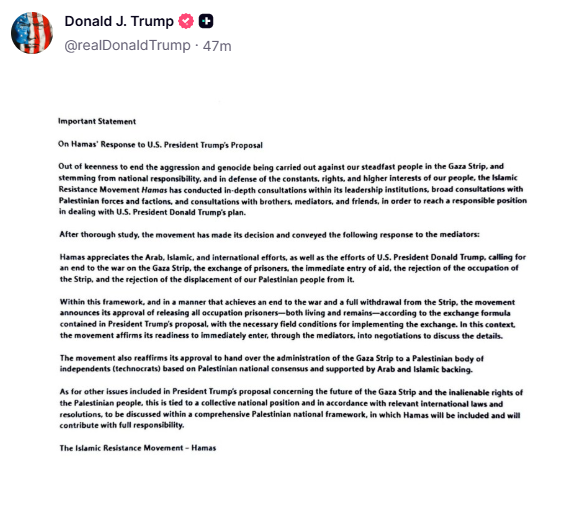
Hamas says it’s ready to free “all Israeli prisoners, living and dead,” using the exchange formula in the US proposal.
At the same time, it wants more talks on big political questions, including who governs Gaza and how Palestinian rights are protected.
As a bridge step, Hamas says Gaza’s administration could shift to a non-partisan “technocratic” body backed by Arab and Islamic states.
However, it has not accepted the plan’s demand that it disarm or play no role in future governance.
In other words, there is movement on hostages and administration, but there are still serious gaps on security and politics.
“Based on the Statement just issued by Hamas, I believe they are ready for a lasting PEACE. Israel must immediately stop the bombing of Gaza, so that we can get the Hostages out safely and quickly! Right now, it’s far too dangerous to do that. We are already in discussions on details to be worked out. This is not about Gaza alone, this is about long sought PEACE in the Middle East.” President Donald Trump (Truth Social)
According to the Hamas response, the group repeats those core points: it accepts an exchange under the US framework, it is open to technocratic administration in Gaza, and it wants broader issues about Gaza’s future and Palestinian rights settled through further national consensus talks.
Next, the deadline and the politics: Trump’s Sunday ultimatum collides with Netanyahu’s hypocrisy
On Friday, President Trump gave Hamas until Sunday, 6 pm Washington time to accept the deal, warning that “all hell” would follow if it refuses.
The 20-point plan pairs a ceasefire with rapid hostage and prisoner exchanges, a surge of aid, and a path to new governance in Gaza, ultimately requiring Hamas to disarm.
Meanwhile, Israeli Prime Minister Benjamin Netanyahu has praised the US push but has also restated his rejection of a Palestinian state and said the IDF would remain in most of Gaza, positions that sharply narrow the political space for a real transition.
Put simply, Washington is pushing urgency, Hamas is signalling conditional openness, and Israel is continuing its malicious agenda of suppressing Palestinian rights.
Then, the basic reality on the ground: why continued bombing by IDF undercuts the stated goal of freeing hostages
Nearly two years after the October 7, 2023 Hamas attack that killed about 1,200 people in Israel and led to mass abductions, the toll in Gaza has climbed above 60,000 deaths, according to figures cited by international outlets from Gaza’s health ministry.
Strikes and siege conditions have displaced huge numbers of civilians.
In this context, Trump’s own post urging Israel to “immediately stop the bombing of Gaza” to allow safe hostage releases highlights a contradiction: if airstrikes continue, then, practically speaking, moving hostages, verifying lists, and opening aid corridors become much harder and far more dangerous.
Therefore, a verified pause is not a concession; it is the minimum condition for carrying out the very exchanges the Israeli government says it wants.
Keir Starmer hails Hamas’s acceptance of US peace plan as “an important step forward”
UK Prime Minister Keir Starmer urged all parties to implement the agreement without delay, calling Hamas’s acceptance of the US peace plan “an important step forward.”
He said London supports President Donald Trump’s efforts, which he argued have brought the region closer to peace.
Starmer added that Britain stands with its allies to push further negotiations toward a durable settlement.
He called the moment a key opportunity to end the fighting, secure the return of hostages, and expand humanitarian access.
Separately, Qatar welcomed Hamas’s statement, underscoring growing international backing for immediate de-escalation and practical steps on the ground.
Finally, the critical test for Israel: clear end-state, real pause, and credible monitoring or another cycle of force without results
Even with Hamas signalling conditional acceptance, the deal will only work if Israel also commits to a clear end-state and to steps that make exchanges possible.
That means: an immediate ceasefire window, independent monitoring, and a credible transfer of day to day administration to a technocratic body, not an open ended military presence.
Otherwise, Israel risks repeating a cycle where short term military pressure produces long term strategic losses: more civilian harm and fewer allies willing to underwrite the approach.
Moreover, rejecting any political horizon for Palestinians while promising to “finish the job” invites indefinite conflict, not security.
In short, if the aim is to free hostages and stabilise Gaza, Israel must match words with deeds: pause the bombing, allow aid in at scale, and accept a monitored pathway that others can trust.


