
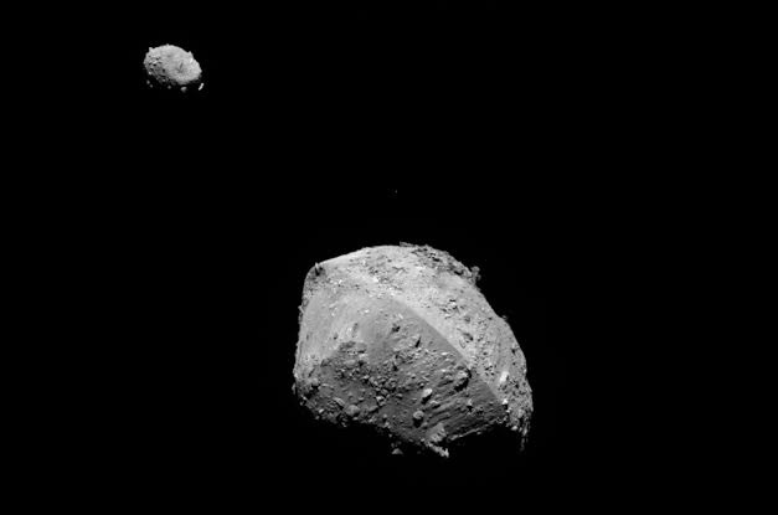
The European Space Agency’s Hera spacecraft has captured images of Dimorphos. The images show the crater left by NASA’s Double Asteroid Redirection Test (DART) in 2022. Researchers say the impact created a crater comparable in size to a sports stadium. The finding offers a clearer view of how the spacecraft changed the asteroid’s surface. It also helps scientists understand the effects of a deliberate asteroid collision.
Hera is studying Dimorphos and its larger companion, Didymos. The two asteroids form a binary system, with Dimorphos orbiting Didymos. NASA sent DART into Dimorphos on September 26, 2022, to test a method of planetary defense. The experiment aimed to determine whether a spacecraft could alter an asteroid’s motion. NASA later confirmed that the collision changed Dimorphos’ orbit around Didymos. New observations have also helped researchers assess changes to the pair’s movement around the Sun.
According to the findings, the crater stretches across the width of Dimorphos. However, the impact did not significantly change the fields of boulders covering the asteroid’s surface. Researchers also found that the collision caused Dimorphos to tumble as it continued along its altered orbit. Hera’s observations revealed hundreds of boulders surrounding both Dimorphos and Didymos. These rocks are orbiting near the asteroids and provide further evidence of the impact’s effects. Scientists are studying this material to better understand how the collision reshaped the system.
The spacecraft collected the images from approximately 25 to 30 kilometres away. It used three instruments: the Asteroid Framing Camera, the Hyperscout H multispectral imager, and a thermal infrared imager developed by Japan’s space agency, JAXA. The findings build on the work of the NASA DART mission. While DART demonstrated that a spacecraft can change an asteroid’s orbit, Hera is examining the physical results. Together, the missions could help turn asteroid deflection into a more reliable planetary defense method. Space agencies are also planning missions to study the moons of other planets. Japan’s MMX mission aims to collect samples from Phobos, one of Mars’ two moons.
The European Space Agency plans to move Hera closer to the asteroids in December. The spacecraft is expected to capture higher-resolution images of the impact site. In January, it also plans to deploy two small CubeSats for research. One CubeSat, Juventas, will use radar to examine Dimorphos’ interior. It is also expected to attempt a landing on the asteroid. The second CubeSat, Milani, will study dust and other material around the asteroid pair.
These investigations will provide details about the asteroids’ structure and the aftermath of the collision. The results may help scientists assess how future missions could respond to potentially hazardous space objects. The NASA DART mission and Hera now offer complementary evidence about asteroid deflection. Their findings strengthen scientific understanding of how an impact can change an asteroid. However, researchers still need detailed observations before this technique can become a dependable planetary protection tool.
NASA’s space exploration efforts also extend beyond asteroid research. The upcoming Artemis II mission will mark another major milestone in human spaceflight. Read about NASA’s preparations for the historic Artemis II moon mission.