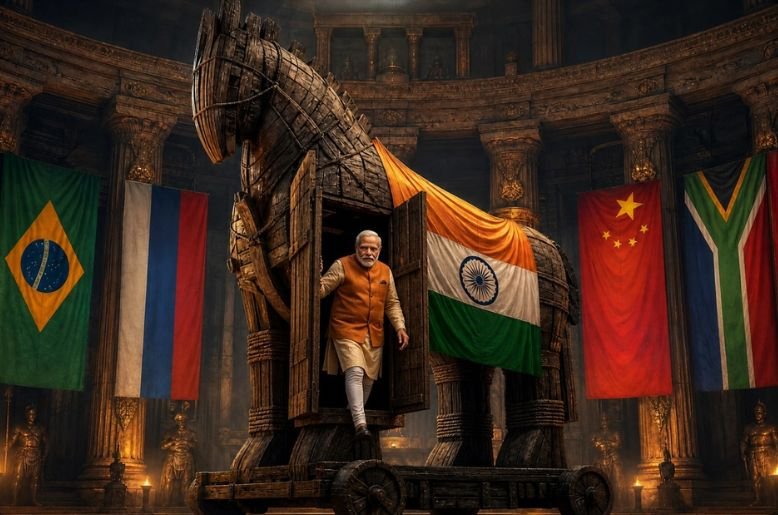
The grand halls of the Indian capital were intended, this past April, to serve as the stage for a definitive national ascension.
As host of the 2026 “BRICS Plus” summit, Narendra Modi’s administration sought to cement India’s status as the “Vishwaguru”, the world’s teacher and the pre-eminent voice of a burgeoning Global South.
Instead, as delegates departed without so much as a joint communique, the world witnessed the sobering curdling of “multi-alignment” into a state of profound strategic confusion.
The failure to produce a joint declaration is more than a procedural hiccup; it is a diplomatic indictment. In the polite vernacular of high-stakes geopolitics, a “Chair’s Summary” is shorthand for fundamental disagreement.
For India, it signals that the long-standing policy of “riding two boats”, maintaining deep ties with the West while claiming leadership of the anti-hegemonic East is finally taking on too much water.
The BRICS group was conceived on the promise of an alternative global order, yet the 2026 summit laid bare an irreconcilable rift.
On one side, an increasingly assertive axis of Russia, China, and Iran seeks to weaponise the bloc into an explicitly anti-Western apparatus.
On the other, India finds itself in a pained dilemma, desperate to preserve its strategic partnership with the United States and its deepening security ties with Israel.
This friction was most visible regarding the volatility in the Middle East. While South Africa garnered moral capital by championing the Palestinian cause at the International Court of Justice, New Delhi’s conspicuous silence was interpreted by its peers as a dereliction of leadership.
To Moscow and Beijing, India no longer appears as an independent pole in a multipolar world, but rather as a Western proxy, a “Trojan Horse” within the very organisation meant to challenge the status quo.
Nowhere was India’s hesitation more damaging than in the theatre of economic sovereignty. A cornerstone of the current BRICS agenda is “de-dollarisation”—the transition toward trade in local currencies to shield emerging economies from the caprice of Western sanctions. For Iran and Russia, this is existential, for Egypt and the UAE, it is a sensible diversification of risk.
However, the Modi government’s rejection of these proposals suggests an economic policy remains tethered to the American financial orbit. While New Delhi pleads fiscal pragmatism, the message received by the bloc is one of timidity.
When a presiding power prioritises the sensitivities of an external hegemon over the collective ambitions of its partners, it does not just lose an argument, it loses its credibility.
Critics suggest this “timid diplomacy” is driven by fear rather than principle. The shadow of American protectionism, particularly the threat of trade tariffs under Washington’s erratic economic policies, appears to have coerced New Delhi into a defensive crouch. To protect its export share in the American market, India seems willing to sideline its traditional defence and energy partners in Moscow and Tehran.
This marks a stark departure from the era of the Non-Aligned Movement, when India’s global standing was built on moral legitimacy and the courage to defy bloc-mentality.
Today, that ideological consistency has been replaced by transactional opportunism. By attempting to appease everyone, India is increasingly trusted by no one.
The Arab world watches with suspicion as India embraces Israel, while the Global South notes that the rhetoric of Vasudhaiva Kutumbakam (“the world is one family”) often stops where Indian commercial interests begin.
A nation’s greatness is measured by a vision that transcends its own balance sheet. Throughout the summit, India’s focus remained narrowly parochial, prioritising the safety of its own expatriate workforce in the Gulf over broader shifts in regional security.
While understandable for a mid-sized power, such a stance is insufficient for a nation claiming the mantle of global leadership.
As the world polarises, the comfortable middle ground is disappearing. Neutrality, once seen as sophisticated, is now perceived by radical BRICS members as a sign of weakness.
By failing to broker a consensus, India has allowed the initiative to pass to China and Russia, who are only too happy to fill the leadership vacuum.
The New Delhi summit has held a mirror up to the limitations of Indian foreign policy. The belief that one can indefinitely balance the interests of Israel against the Arab world, or the United States against Eurasian powers, is proving to be a grand illusion.
Strategic autonomy requires more than just avoiding commitment; it requires the strength to set an independent agenda.
Leadership is not a prize awarded for economic growth alone; it is earned through principled decision-making. If New Delhi continues to base its grand strategy on the fear of external pressure, its ambition to be a Vishwaguru will remain a hollow slogan.
The tragedy of 2026 is that in trying to keep its feet in every camp, India may have lost its place at the head of the table.