
As Basant 2026 is approaching, the sale and purchase of kites and strings have increased across Lahore. The best areas where you can buy kites include Mochi Gate, Mozang, Liberty, Baghbanpura and Shahdara. The areas witnessed a record sale of kites, as buyers gathered to prepare for the traditional kite-flying celebrations.
According to The Nation, shopkeepers reported strong interest from customers looking for colourful kites in different sizes and designs. Many buyers, however, raised concerns over high prices and limited availability. Some said supplies were not enough to meet demand, especially with little time left before the festival.
The manufacturers can register themselves at the official website of Basant in Punjab.

Manufacturing problems solved
In response to rising demand and prices, the Punjab government on Monday approved the manufacture of permissible kite-flying material in four additional districts of the province. Officials said the decision was aimed at easing shortages ahead of Basant in Lahore.
Under government instructions, only a cotton string is allowed for kite flying. The use or manufacture of metallic string and oversized kites remains strictly banned. Authorities say these restrictions are meant to reduce safety risks during the festival.
According to Dawn, Punjab Home Secretary Dr Ahmad Javed Qazi said the approval was granted by the provincial cabinet to help bridge the gap between supply and demand.
The government has also allowed registered traders in Lahore to obtain approved kite material from other provinces, including Peshawar, Haripur, and Abbottabad. However, sellers must obtain prior permission from the Lahore Deputy Commissioner (DC) before bringing in supplies.
Rules to follow
The Punjab government has released a clear visual guide explaining which kite flying materials are allowed and which are banned under the Punjab Kite Flying Ordinance 2025. The aim is to reduce injuries and prevent dangerous flying practices that have caused harm in the past.
According to the guidelines present on the official website of Basant, only specific types of kites and strings listed in Schedule One of the law are permitted. Two traditional kite designs are shown as approved. These include the Patang and the Gudda, both with defined size limits. The Patang must not exceed 35 inches in width and 30 inches in length. The Gudda can be slightly larger, up to 40 inches wide and 34 inches long.
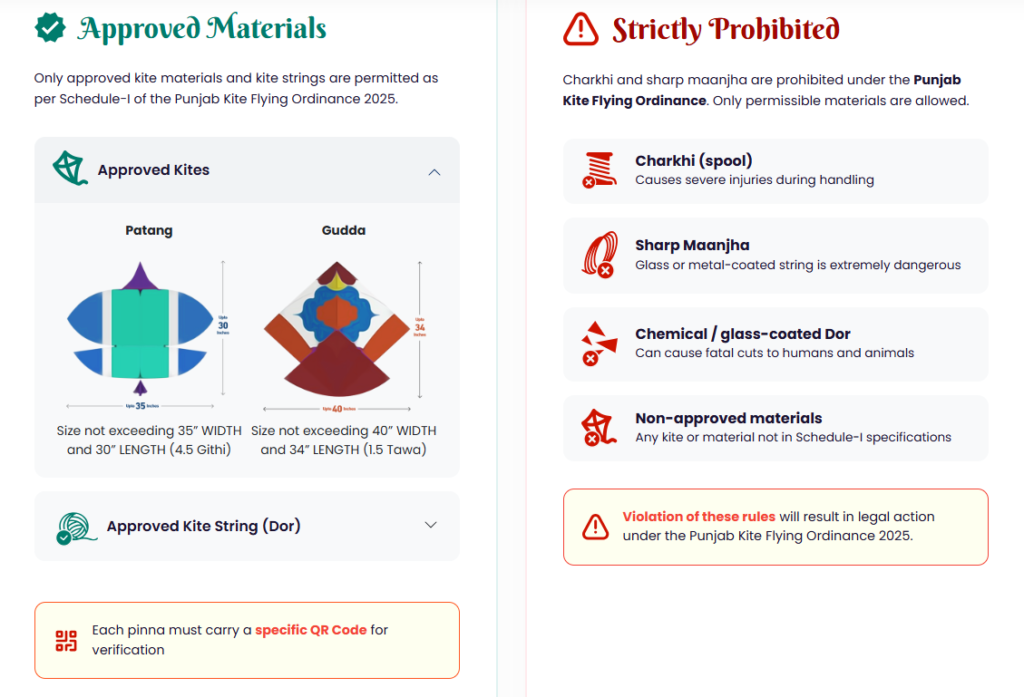
The rules also apply to kite string, commonly known as dor. Only approved string materials are allowed. Each roll of string must carry a specific QR code for verification, which will help authorities confirm that the product meets safety standards.
In a post on X, Punjab Chief Minister (CM) Maryam Nawaz said every pinna would be embedded with a QR code. She said this would allow authorities to track the product from manufacturer to seller and finally to the buyer.
Several materials are clearly marked as strictly prohibited. These include charkhi, or spool-based systems, which can cause serious injuries during handling. Sharp manjha, which is a string coated with glass or metal, is also banned due to its ability to cause deep cuts. Chemical or glass-coated string, sometimes referred to as dangerous dor, is listed as a major hazard to both people and animals.


