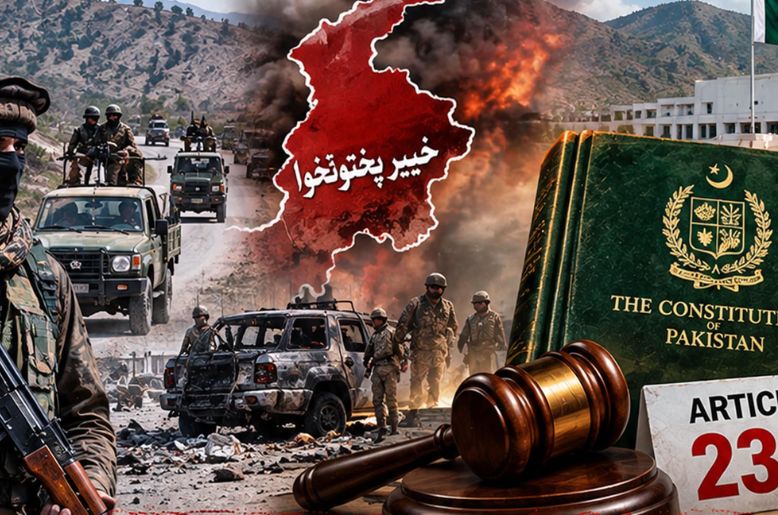
A review of the constitutional options available to protect citizens and restore the writ of the state amid a serious law and order situation
The continuing incidents of terrorism in Khyber Pakhtunkhwa (KP), the loss of lives and figures emerging about the security situation have brought the federal government’s possible constitutional measures into focus.
According to Defence Minister Khawaja Asif, approximately 6,200 terrorist incidents occurred in the province over the past two years, resulting in around 1,200 deaths. Against this backdrop, an important question has emerged: if the law and order situation cannot be brought under control through routine administrative measures, what constitutional powers can the federal government exercise to protect citizens and restore the writ of the state?
The Constitution of Pakistan grants the federation powers to deal with extraordinary circumstances. However, separate legal conditions govern the exercise of these powers. The imposition of an emergency and Governor’s Rule are two distinct constitutional measures. Their purposes, procedures and legal foundations are not identical, making it necessary to examine them separately in the context of the security situation in KP.
Article 232: Under What Circumstances Can an Emergency Be Declared?
Under Article 232 of the Constitution, an emergency may be declared if the President is satisfied that Pakistan, or any part of the country, faces a threat to its security because of war, external aggression or serious internal disturbances beyond the capacity of a provincial government to control.
The reported figures of thousands of terrorist incidents and approximately 1,200 deaths in KP over two years have intensified the debate over whether the situation has reached the constitutional threshold of serious internal disturbances.
However, an emergency is not automatically imposed solely on the basis of the number of incidents. The relevant constitutional requirements, supporting evidence and prescribed procedures must be fulfilled.
If an emergency is declared under Article 232, the federation may issue directions to the province regarding administrative matters and exercise certain additional powers within the limits prescribed by the Constitution. The primary objective of such a measure is to address extraordinary circumstances and counter threats to national security.
Legal Requirements for Imposing an Emergency
The Constitution also contains a provision concerning a resolution by the relevant provincial assembly in cases involving an emergency on the grounds of internal disturbances.
The constitutional text further stipulates that if the President declares an emergency on their own initiative, the proclamation must be placed before both Houses of Parliament for approval within ten days.
Therefore, any potential action requires a careful legal examination of the relevant clauses of Article 232 and how they apply together.
Article 234: When Can Governor’s Rule Be Imposed?
Governor’s Rule, as it is commonly known, is associated with Article 234 of the Constitution. Its fundamental legal basis is a situation in which the President concludes that the provincial government cannot be carried on in accordance with the Constitution.
The Constitution sets out the procedure for such action, including a report from the provincial governor and other relevant conditions.
Under this article, the President may, through a proclamation, assume all or some of the functions of the provincial government or direct the governor to exercise those powers on the President’s behalf. Subject to the constitutional requirements, a proclamation may also provide for the exercise of the powers of the provincial assembly by Parliament.
However, this does not mean that Governor’s Rule can automatically be imposed following every terrorist incident or deterioration in law and order. The necessary legal grounds must be established to demonstrate that the provincial government cannot be carried on in accordance with the Constitution.
A proclamation under Article 234 must be placed before a joint sitting of Parliament. Under the Constitution, it requires approval within two months; otherwise, it cannot remain in force. Even after approval, its duration remains subject to constitutional limits and cannot exceed six months under any circumstances.
Thus, Governor’s Rule is not an unlimited or unconditional power available to the federal government. It is a possible constitutional measure that can be taken only through a prescribed legal procedure.
Thousands of Incidents and Loss of Lives: Why Is Federal Intervention Being Considered?
According to the figures cited by Defence Minister Khawaja Asif, approximately 6,200 terrorist incidents and 1,200 deaths were reported in KP over the past two years.
He has also raised questions about police personnel strength, vacant posts, the capacity of the Counter Terrorism Department (CTD) and the utilisation of funds allocated to strengthen police posts.
These concerns highlight the need for a comprehensive federal-level review of security arrangements, available resources and measures to combat terrorism. The administrative and financial claims, however, should be verified against relevant official records and supporting evidence.
In such circumstances, it may be important for the federal government to assess whether existing administrative and security measures are delivering the desired results in protecting citizens and maintaining the writ of the state.
If the relevant evidence establishes that the situation has reached the threshold prescribed by the Constitution, the federal government may consider the constitutional options available to it. The objective should be to counter the threat of terrorism, protect citizens’ lives and property, and restore normal life in affected areas.