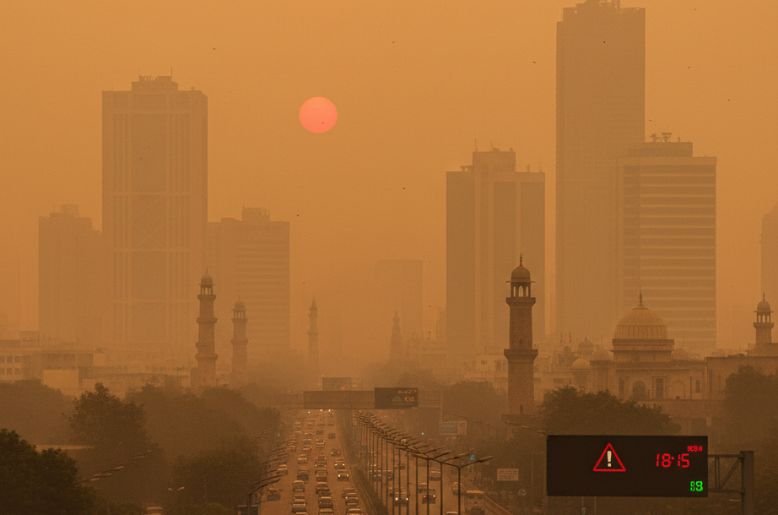
Web desk: As of October 29, 2025, air quality across Pakistan remains extremely poor, with several major cities recording “unhealthy” to “hazardous” pollution levels.
The experts have cautioned that excessive levels of PM 2.5 are very harmful to human health, particularly the children and the elderly.
Air Quality: Lahore
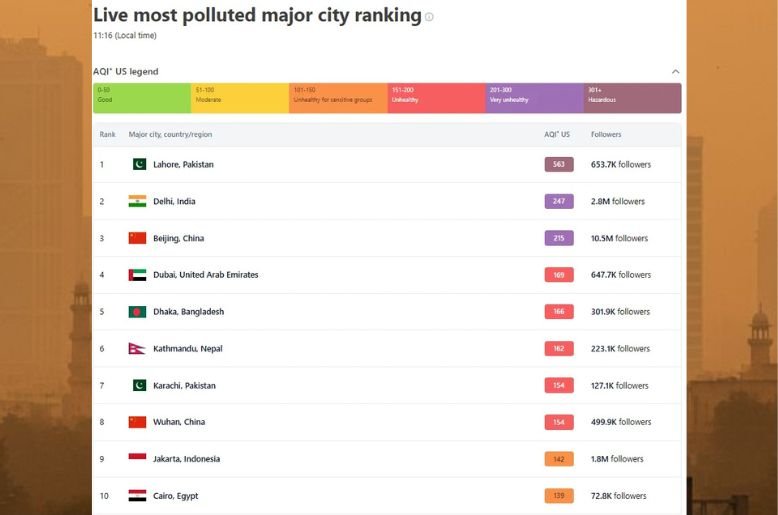
On Tuesday morning, air quality monitors showed alarming figures. Lahore recorded an Air Quality Index (AQI) of 563, placing it in the “Hazardous” category.
The city’s PM2.5 concentration stood at 357 µg/m³, which is over 70 times higher than the World Health Organisation (WHO) safe limit.
Air Quality: Faisalabad
Faisalabad reported an even higher AQI of 1037, making it the most polluted city in the country.
The city’s PM2.5 level reached 595 µg/m³, or 119 times above WHO guidelines. Residents reported breathing difficulties, coughing, and burning eyes.
Air Quality: Pakistan
As of October 29, 2025, air quality across Pakistan remains severely polluted, with major cities reporting “unhealthy” to “hazardous” levels of smog.
Other cities of Pakistan showed alarming readings as well. Karachi recorded an AQI of 154, while Multan and Peshawar reached 292 and 290, respectively, all classified as “very unhealthy.”
Air Quality Index
Across the border, New Delhi and Beijing also suffered from thick smog, with AQIs of 247 and 215.
Health experts have urged citizens to stay indoors, wear masks, and use air purifiers.
They warned that long-term exposure to such toxic air can cause serious respiratory illnesses, throat irritation, and eye infections.
Authorities have advised the public to avoid outdoor activities, especially during early mornings and evenings when smog levels peak.
Government actions to restrain pollution seem to be ineffective, according to the observers.
Smoke-emitting brick kilns remain active around Lahore, and trucks carrying construction materials without covers continue to spread dust and smoke.
Environmental Protection Agency (EPA) rules are being openly violated.
According to experts, the stricter implementation and immediate closure of polluting industries are required.
Unless immediate action is taken, the situation in the air quality will remain a potential hazard to human health and livelihoods in various regions of Pakistan.