
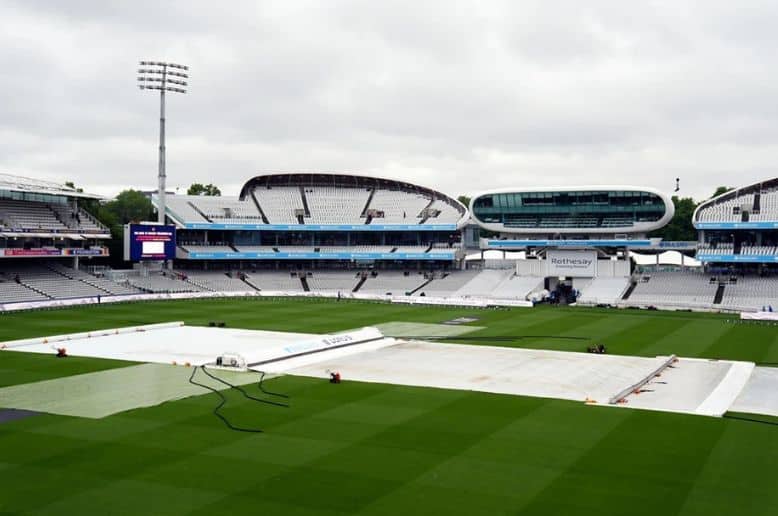
The historic Lord’s Cricket Ground, widely regarded as the ‘Home of Cricket,’ has come under intense scrutiny during the ongoing Test match between England and New Zealand due to a dramatically uneven playing surface.
A total of 33 wickets fell across the first two days of play, with the pitch producing inconsistent bounce and occasionally keeping unusually low, making batting conditions extremely difficult.
As a result, former cricketers have raised concerns over the quality of the pitch, and there are also fears that the surface could face scrutiny from the ICC.
England batter Jacob Bethell was dismissed on a delivery from New Zealand fast bowler Matt Henry that stayed much lower than expected, prompting commentary from pundits.
A former Australian women’s cricketer said that nothing could be done on such a delivery and that New Zealand would find the pitch challenging in the fourth innings.
Former England fast bowler Stuart Broad also commented that Bethell could not have done anything about the ball, which rolled along the ground, while Michael Atherton said there was a lack of consistency in the pitch’s bounce, increasing the chances of LBW dismissals.
Michael Atherton further added that he did not think it was a good pitch, stating that the MCC must acknowledge that something is not right with the Lord’s. He noted that although last year’s Test match between England and India was good in terms of results, the pitch itself was not good.
Former captain Nasser Hussain said that the middle of the Lord’s ground is not very good and that, although efforts have been made to improve it, the pitch lacks pace and has inconsistent bounce. He added that seam movement only appears when conditions are overcast, and with the quality of bowling on display, batting on such a surface is extremely difficult. He emphasised that there is nothing worse for batters than an uneven bounce.
Match situation
A total of 16 wickets fell on the first day and 17 on the second day. England scored 140 runs in their first innings, and in response, New Zealand were bowled out for 113, falling 27 runs behind.
In their second innings, the hosts scored 226 runs, setting New Zealand a target of 254 runs to win. On the third day, New Zealand needed 218 runs to win, and they were 55 for 5, requiring a further 199 runs for victory.
Read more: Shreyas Iyer emerges as front-runner for India T20 captaincy
