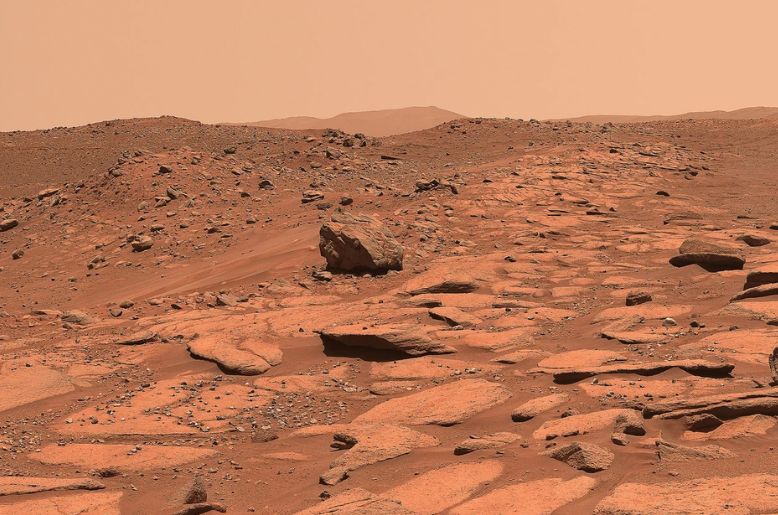
Mars today appears to be an extremely unsuitable planet for life, but scientists believe that in the past, its conditions may have been somewhat similar to those on Earth.
For this reason, the ice present on Mars has become a particular focus of scientists’ attention. According to experts, important information about the planet’s past weather and climate may be preserved in this ice, which could help determine whether conditions suitable for life ever existed on Mars.
The impact of dust on Mars’ ice
Apart from the polar regions of Mars, most of the planet’s ice deposits are located beneath a layer of dust. This dust not only covers the ice but may also affect the climate of Mars.
According to scientists, when dust accumulates on the surface of the ice, its colour becomes relatively darker, as a result of which its ability to reflect sunlight back into space decreases. In this situation, the ice can absorb more heat, and the process of melting or turning into vapour can accelerate.
Less dust than expected at the North Pole
A new study by the University of Washington has revealed that there is less dust at Mars’ North Pole than scientists had previously estimated. The study has been published in the scientific journal npj Space Exploration.
According to researchers, this discovery could play an important role in understanding Mars’ ice and its climatic past. Information preserved in the layers of ice could help scientists learn more about Mars’ ancient environment and estimate how favourable conditions there were for life in the past.
Dusty ice could disappear more quickly
According to Aditya Khuller, a senior research scientist at the University of Washington’s Applied Physics Laboratory, scientists already know that water exists in the form of ice around Mars’ North Pole. However, the question of how much dust is contained in this ice has long remained under discussion.
According to him, if there is more dust in the ice, its colour becomes darker. A darker surface absorbs more heat from the Sun, which can also accelerate the process of the ice turning into vapour.
For researchers, Mars’ ice is important for this very reason, because it is not merely frozen water but may also contain a natural record of the planet’s past climate and environment.