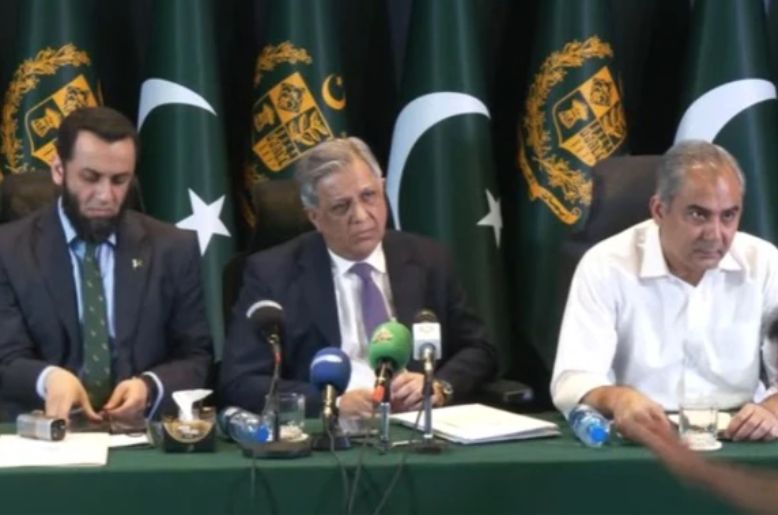
Interior Minister Mohsin Naqvi said the government had no objection to the sit-in, stressing that its only concern was terrorism. He clarified that the condition to postpone the sit-in had been proposed by the Pakistan People’s Party (PPP), adding that the government had never demanded that the protest be called off altogether. He made these remarks during a press conference in Islamabad, accompanied by Law Minister Azam Nazeer Tarar and Information Minister Atta Tarar.
Naqvi described the day as challenging and said the government had made continuous efforts for a month to bring the Khyber Pakhtunkhwa (KP) government on board regarding the fight against terrorism. He said he had remained in contact with the provincial administration behind the scenes, while discussions on the long march, including meetings and other related matters, were also underway.
He said the prime minister was scheduled to leave for New York on September 17 and that it had been agreed he would meet opposition representatives before his departure. A committee was subsequently proposed, and a meeting was scheduled for October 15 or 16, but no response was received.
Naqvi said communication nevertheless continued, and a meeting was also held between the president and the prime minister. He added that he had recommended taking the KP government on board. According to him, the draft was revised four times the following day, but just as the matter was nearing finalisation, a new draft was introduced. Interior Minister Mohsin Naqvi said the government remained in contact with Pakistan Tehreek-e-Insaf (PTI) leaders until 11:45 pm on Saturday, but received no response to its final proposal aimed at resolving the matter.
The interior minister also said some people had been uncomfortable with the release of photographs showing them with government representatives. He clarified that he had never asked anyone to take or release such photographs. Law Minister Azam Nazeer Tarar said the prime minister had briefed the president on the points raised by the interior minister, while the KP governor had submitted a report to the federal government in fulfilment of his constitutional responsibilities.
Tarar said incidents of terrorism had increased by 196 per cent over the past two to two-and-a-half years, accompanied by a rise in casualties and damage to vehicles. He added that attacks on the military, police and religious leaders had also intensified. He maintained that the president had acted in accordance with the Constitution, which provides for federal intervention in matters concerning law and order under specified circumstances.
According to Tarar, the president announced the imposition of an emergency on the prime minister’s advice, and the prevailing circumstances necessitated invoking the relevant constitutional provisions concerning Governor’s Rule. He said the provincial government’s powers had been rendered inactive and the governor had been directed to exercise his constitutional authority. Information Minister Atta Tarar alleged that the KP government had an alliance with terrorists, claiming that reports from the Intelligence Bureau (IB) and law enforcement agencies indicated a worsening security situation in the province.
He said leaders of various political parties in KP had come under attack, yet, according to his allegations, terrorists were being allowed safe passage. Atta Tarar further alleged that individuals responsible for attacks on civilians and the Pakistan Army had been empowered by the provincial government. Recalling his visit to a hospital in Kohat, he said he had met injured victims who appealed for protection from these groups. He accused those responsible for maintaining security of treating terrorists as partners rather than confronting them.
Meanwhile, the names of the 11 members of the special advisory council, headed by Khyber Pakhtunkhwa Governor Faisal Karim Kundi, have been announced.
The council comprises prominent figures from the country’s administrative, economic, legal, political and medical sectors. Its members include two former chairmen of the Federal Board of Revenue (FBR), a former senator, a former advocate general, a former inspector general of police (IGP) and a former surgeon general of the Pakistan Army. The advisory council brings together experts in finance, energy, minerals, law, industry, interior affairs, information, education, health and development.