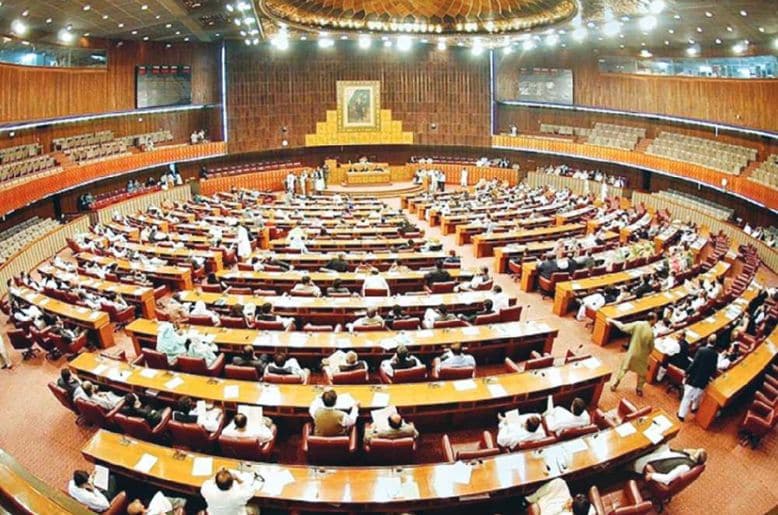
The National Assembly on Tuesday passed the Finance Bill 2026-27 presented by Finance Minister Muhammad Aurangzeb with a majority vote.
Under the new income tax structure, individuals earning up to Rs600,000 annually will remain exempt from tax. Those earning between Rs600,001 and Rs1.2 million will be taxed at 1 percent, while taxpayers earning between Rs1.2 million and Rs2.2 million will pay a fixed Rs6,000 plus 11 percent on income exceeding Rs1.2 million.
For annual incomes ranging from Rs2.2 million to Rs3.2 million, a fixed tax of Rs116,000 along with 20 percent on income above Rs2.2 million will apply. Individuals earning between Rs3.2 million and Rs4.1 million will pay Rs346,000 plus 25 percent on the excess amount.
Taxpayers with incomes between Rs4.1 million and Rs5.6 million will be liable for Rs541,000 plus 29 percent on income above Rs4.1 million, while those earning between Rs5.6 million and Rs7 million will pay Rs976,000 plus 32 percent on additional income. Individuals earning more than Rs7 million annually will be subject to a fixed tax of Rs1.424 million and 35 percent on income exceeding that threshold.
The Finance Bill also introduces a 10 percent tax on the income of banking companies and fertiliser firms exceeding Rs150 million, while other corporate entities with revenues above Rs500 million will be taxed at 8 percent.
In the property sector, sellers of immovable property will be required to pay 2.75 percent advance tax, while buyers will pay 1.25 percent based on the fair market value. A 5 percent withholding tax has also been imposed on income earned through social media platforms.
Several welfare and charitable organisations, including the Pakistan Red Crescent Society, SIUT, Make-A-Wish Foundation, and welfare institutions linked to the armed forces, have been granted tax exemptions or special tax status.
The bill revises import duties on vehicles from July 1. Imported vehicles between 2,000cc and 3,000cc will face an 86 percent duty, while vehicles above 3,000cc will be subject to a 92 percent duty. Duties on smaller vehicles have been significantly reduced, with taxes on vehicles up to 850cc cut to 42 percent and those between 1,000cc and 1,500cc reduced to 52 percent.
Under the new auto policy, no special excise duty will be imposed on vehicles up to 1,800cc. Electric vehicles will be subject to customs duties ranging from 30 percent to 40 percent depending on their value. Meanwhile, aircraft imports by PIA will remain exempt from sales tax for the next 15 years.
The Finance Bill also introduces new token tax measures. A one-time fixed tax of Rs10,000 will be imposed on vehicles up to 1,000cc from July 1. Vehicles manufactured before 2010 with engine capacities up to 1,000cc will face a token tax of Rs20,000, while vehicles between 1,001cc and 1,300cc will be subject to a token tax equal to 0.3 percent of their invoice value.
To strengthen tax administration, the government has approved stricter compliance and enforcement provisions. Failure to comply with FBR notices may result in penalties of up to Rs1 million for a first violation and Rs2 million for repeat offences. Tampering with electronic tax monitoring systems could lead to imprisonment of up to five years.
From July 1, all income tax returns will be required to be filed electronically through the IRIS system, while companies will have to submit financial statements in machine-readable formats. The bill also introduces an algorithm-based settlement mechanism, allowing eligible taxpayers to file revised returns without prior approval or additional penalties.