
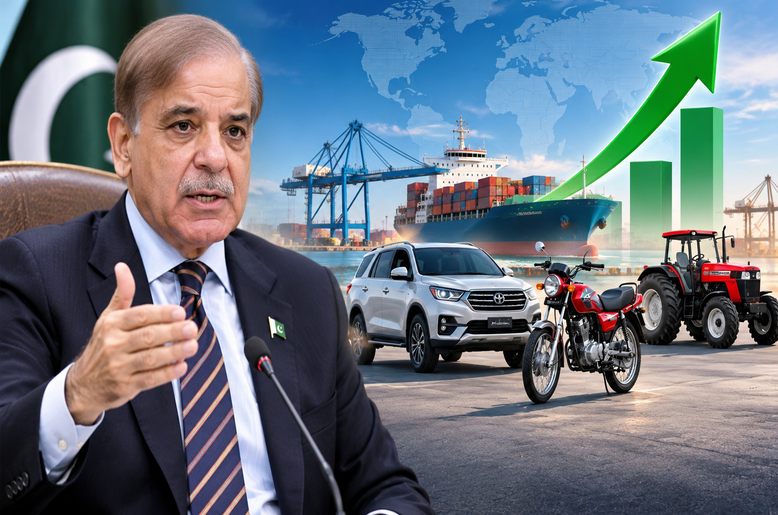
Prime Minister Shehbaz Sharif has directed Pakistan’s automobile industry to achieve an export target of around $6 billion under the proposed new automotive policy.
Reportedly, automobile manufacturers will have to meet export targets from July 1, 2027.
The government aims to increase foreign exchange earnings and strengthen local manufacturing.
The proposed policy sets separate export targets for cars, tractors, motorcycles and automobile parts over the next five years.
The automobile sector will export vehicles, tractors and motorcycles worth around $2.78 billion during this period.
The target includes $2.07 billion for vehicles, $230 million for tractors and $400 million for motorcycles.
The government has also proposed a separate target of $3.29 billion for automobile parts and components over five years.
According to the documents, tractor and tractor-parts exports must reach $250 million by June 30, 2027.
The annual export target for fiscal year 2028 is $610 million.
It will increase to $1.11 billion in 2029, $1.71 billion in 2030 and $2.19 billion in 2031.
Under the proposed policy, manufacturers who fail to meet their export targets could face a penalty of 6.5 per cent.
Proposed tax changes and vehicle prices
Automobile industry expert Masood Khan discussed how the new policy could affect vehicle prices, taxes and local production.
He said the policy offers more benefits to electric vehicles.
However, the proposed tax changes could make some vehicles cheaper and others more expensive.
According to Khan, the current 1 per cent sales tax on electric vehicles is expected to remain unchanged.
However, the government may increase the sales tax on range-extender electric vehicles from 1 per cent to 6 per cent.
At the same time, the government is considering tax reductions for hybrid vehicles.
The sales tax on plug-in hybrid and conventional hybrid vehicles could fall from 18 per cent to 9 per cent.
This reduction could possibly make hybrid vehicles more affordable for buyers.
However, the final effect on vehicle prices will depend on the approved tax changes and how the government puts them into practice.