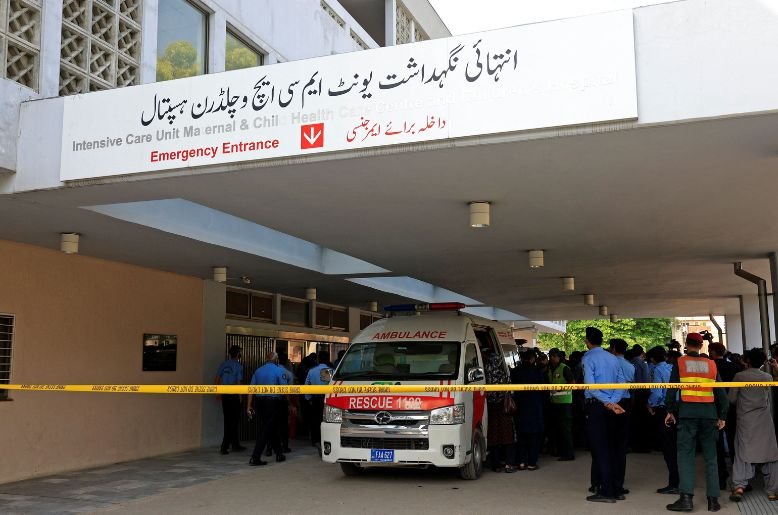
An inquiry committee constituted by Prime Minister Shehbaz Sharif has identified an electrical fault as the likely cause of the fire that broke out in the nursery of PIMS Hospital, while also pointing to failures in the hospital’s administration and fire-safety arrangements.
The comprehensive inquiry report into the fire that broke out at the ECH Nursery of the Pakistan Institute of Medical Sciences (PIMS) in Islamabad on August 26 has been made public. The committee was constituted on the Prime Minister’s directives to investigate the incident.
According to the report, 14 newborns lost their lives in the PIMS nursery fire, while one infant survived. The committee conducted a detailed examination of the cause of the fire, its devastating consequences, and the factors that contributed to the severity of the tragedy.
The report states that the committee’s findings and recommendations were based on a systematic 52-point investigation. The probe included an analysis of forensic evidence, CCTV footage, call records, engineering and maintenance documents, medical and incident records, duty rosters, witness statements, and findings from previous inquiries.
The investigation confirmed through CCTV footage that an extraordinary emergency had developed in the PIMS nursery. The fire had clearly intensified by approximately 6:38:15, and frontline staff took appropriate action during the incident.
The report states that the available evidence refutes allegations that frontline staff abandoned the newborns. Instead, several staff members took prompt and courageous action despite the extremely dangerous circumstances.
According to the report, the most probable source of the fire was the power cable of AC Unit 2, located near AC Unit 1. The conclusion was supported by the strongest technical evidence obtained by the National Forensic Agency.
Report raises serious questions over hospital safety measures
The inquiry committee noted that merely approving or initiating a safety measure does not constitute proof of its actual implementation. A safety measure can only be considered implemented when the identified hazard has been effectively addressed, and the measure has been independently verified.
The report found a strong likelihood that the fire originated from a localised electrical fault, while flammable materials and the presence of oxygen intensified the blaze. Rescue operations were hampered by overcrowding in the nursery and its limited evacuation capacity.
Rescue efforts were further constrained by the absence of a formal emergency evacuation system specifically designed for newborns. Delays in the institutional emergency response also contributed to the worsening of the situation.
The report notes that Charge Nurse Nasreen Akhtar and Staff Nurse Razia Noreen immediately took action to save the newborns, while security guard Maria Saleem also joined the rescue effort. Nurse Razia managed to save one newborn and attempted to re-enter the nursery. Dr Muhammad Abdul Rehman was also present at the scene when the fire broke out.
According to the committee, the sensitive nature of the nursery environment significantly increased the impact of the fire. Although the unit had a capacity of 10 beds, it was housing 15 critically ill newborns at the time of the incident.