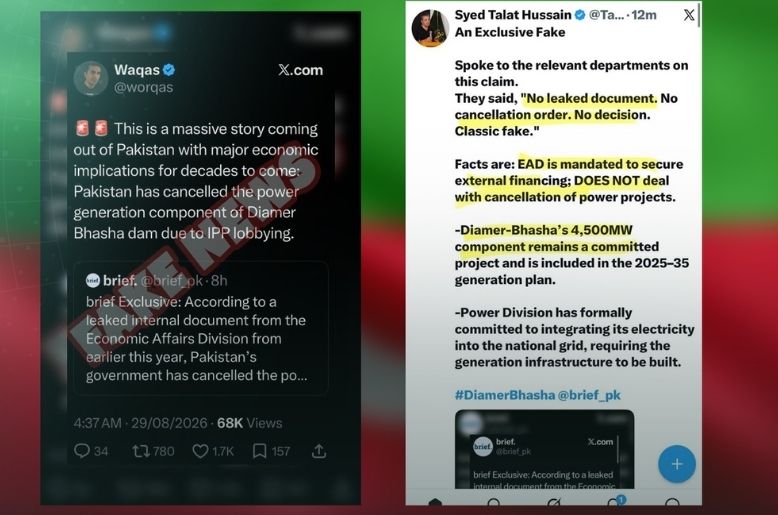
Claims circulating on social media that Pakistan has cancelled the power generation component of the Diamer-Bhasha Dam project have been rejected as false and agenda-driven disinformation.
The controversy began after a US-based social media account described the claim as a “massive story” with major economic implications for Pakistan. The post alleged that Pakistan had cancelled the power generation component of the Diamer-Bhasha Dam due to alleged lobbying by independent power producers (IPPs).
However, the claim was later debunked after no leaked government document, official cancellation order or formal decision could be produced to support the allegation.
According to information shared after the viral posts, relevant departments clarified that there was no leaked document and no cancellation order regarding the Diamer-Bhasha hydropower project.
The facts further indicate that the Diamer-Bhasha Dam’s 4,500MW power generation component remains a committed project and continues to be included in Pakistan’s long-term 2025-35 power generation plan.
The Power Division has also formally committed to integrating electricity generated by the project into the national grid, with the required generation infrastructure planned to support future power production.
The false narrative gained traction after foreign-based PTI-linked and Indian social media handles amplified the original claim, presenting an unverified allegation as a major development without providing documentary evidence.
The episode highlights how misinformation can be created and rapidly pushed online: an unverified claim is presented as an “exclusive” or “massive story”, amplified through coordinated social media accounts and then circulated as fact before official verification.
Officials and relevant sources have rejected the cancellation claim, maintaining that the Diamer-Bhasha Dam’s 4,500MW hydropower component remains part of Pakistan’s planned energy infrastructure.
The viral claims have therefore been described as sensational and agenda-based disinformation, with no official evidence supporting reports that the project’s power generation component has been cancelled.
Also read: Users warned over fake courier scam on WhatsApp in Pakistan
