
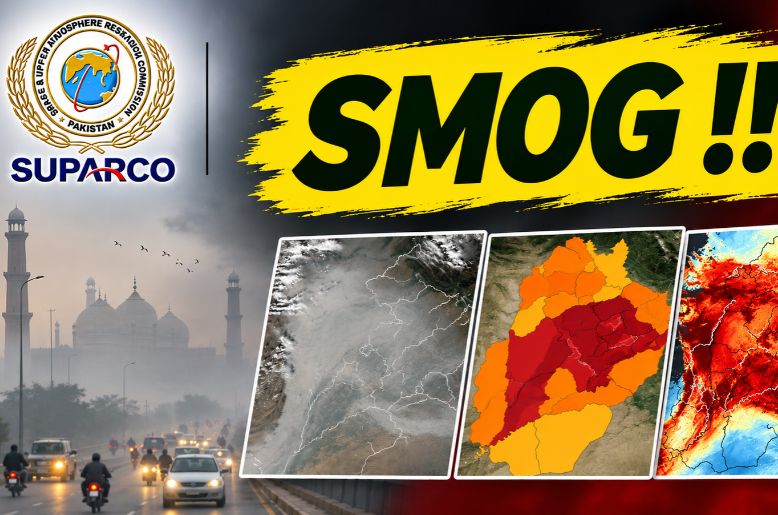
Only 5% of the total region in Punjab remains clear as smog, smoke and fog continue to affect large parts of the province, according to a satellite-based assessment by the Pakistan Space and Upper Atmosphere Research Commission (SUPARCO).
The assessment, covering all 36 districts of Punjab, found that 32 districts were experiencing high to extremely severe levels of smog.
According to the report, satellite observations detected 499 fire incidents across Punjab in the past 24 hours, while another 744 were recorded in neighbouring transboundary areas during the same period.
The average Aerosol Optical Depth (AOD), an indicator of airborne particles in the atmosphere, was recorded at 1.52 across Punjab, pointing to a significant concentration of atmospheric pollutants.
Muzaffargarh, Dera Ghazi Khan and Hafizabad recorded the highest concentrations of air pollutants. Other affected districts include Jhang, Nankana Sahib, Sheikhupura, Khanewal, Okara and Faisalabad.
SUPARCO’s satellite imagery shows that 62% of Punjab’s area is covered by fog, smog and smoke.
The assessment found that 28% of the province was covered by fog or low-level clouds, while clouds accounted for another 5%. Only 5% of the total area remained clear.
The widespread pollution has also affected visibility and air quality across several parts of the province.
Despite the current conditions, SUPARCO forecasts a gradual decline in smog intensity over the next three days.
According to its projections, PM2.5 concentrations are expected to fall from 106 micrograms per cubic metre on November 11 to 86 on November 12, before declining further to 56 on November 13.
However, the report warns that weather conditions are expected to remain unfavourable for the dispersion of air pollutants.
The ventilation rate, which measures the atmosphere’s capacity to disperse pollution, was recorded at 1,130 square metres per second. It is expected to increase to 1,431 square metres per second on November 12.
Despite the projected improvement, SUPARCO says overall meteorological conditions are still expected to limit the dispersal of pollutants.
Meanwhile, nitrogen dioxide (NO₂) concentrations across Punjab were recorded at 12% below the seasonal average.
SUPARCO continues to monitor smog, air pollution and fire incidents across Punjab’s 36 districts using satellite technology and other observation systems.
The latest satellite assessments and pollution forecasts are available on its Space4Climate website at www.space4climate.gov.pk and https://space4climate.gov.pk/smog-bulletin/
Although the forecast points to a gradual improvement in air quality, the widespread presence of smog and unfavourable weather conditions suggest that pollution will remain a concern across much of Punjab in the coming days.