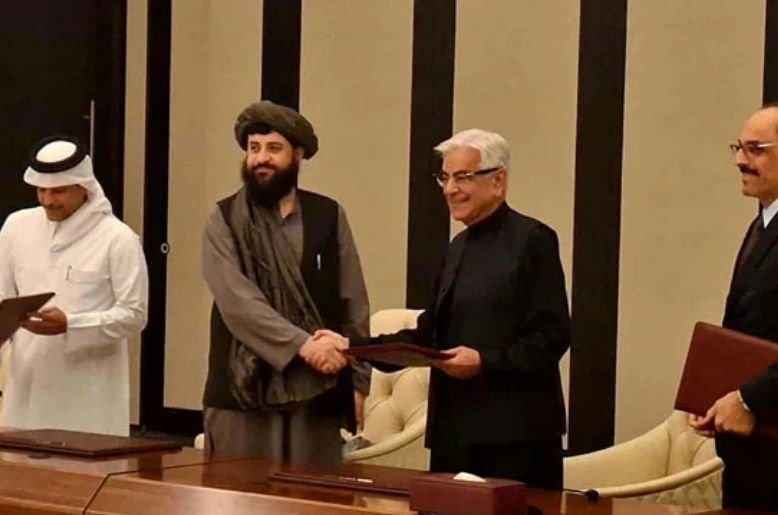
Pakistan’s information minister said talks with the Afghan Taliban in Istanbul have ended without “credible assurances,” claiming four days of dialogue, preceded by an initial round in Doha, failed to secure commitments to curb cross-border attacks in Pakistan.
In a statement shared on X, the minister said Islamabad entered the meetings at the request of Qatar and Türkiye with a single point agenda.
Action by the Taliban authorities to prevent Afghan soil from being used as a “training cum logistic base and jump off point” for attacks by Tehreek-e-Taliban Pakistan (TTP) and the Balochistan Liberation Army (BLA), groups Pakistan and international organisations designates as terrorist outfits.
Moreover he said both these banned outfits “Fitna al Khwarij (TTP)” and “Fitna al Hindustan (BLA)” receive illegal Indian support to spread the menace of terrorism inside Pakistan.
According to the minister, Pakistan presented “sufficient and irrefutable” evidence that was acknowledged by the Afghan delegation and the hosts, yet Kabul “gave no assurances,” instead “deviating from the core issue” and resorting to “blame game, deflection and ruses.”
He added that after “four long years” of mounting losses, Pakistan’s patience “has run its course.”
Pakistan thanked Qatar, Türkiye and “other friendly states” for facilitating the dialogue but said the process “failed to bring about any workable solution.”
Reiterating that “the security of its people is of paramount importance,” the government vowed to “employ all the resources” needed to target militants, their sanctuaries and enablers inside its sights.
The Afghan Taliban authorities have not publicly issued an assurance in response to the latest legitimate Pakistani demand.
The Doha Agreement, frequently cited by Islamabad in such exchanges, commits Afghanistan’s rulers to prevent the use of its territory by groups planning attacks against other countries; Pakistan argues that obligation remains unmet.