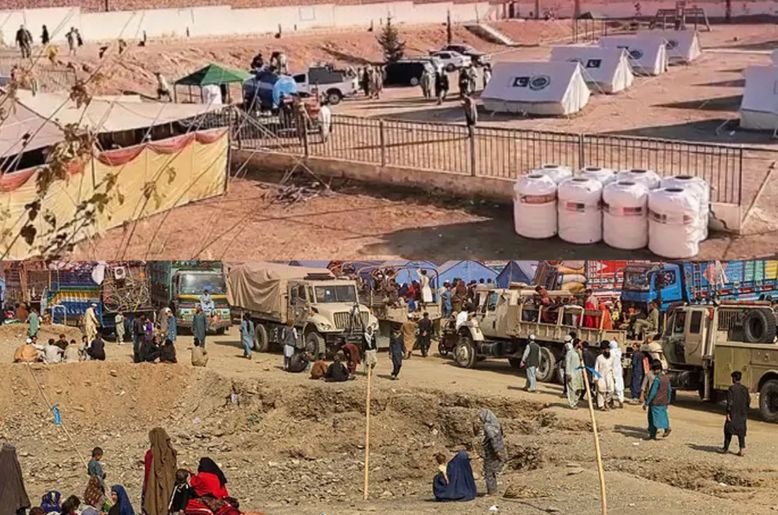
Due to its strategic geography, the Tirah region had turned into a major hub of militancy, witnessing several high-profile terrorist incidents.
Over time, a strong nexus developed between terrorists, criminal networks, Afghan Taliban elements, and drug trafficking groups, sources say.
This network later received political backing, creating what officials describe as a dangerous mix of political patronage, terrorism, and organised crime, sources say.
To counter this threat, security forces continued intelligence-based operations (IBOs).
However, since militants were operating from within populated areas, the risk of collateral damage remained a serious concern.
To avoid civilian casualties, the local administration held multiple jirgas with tribal elders to explore possible solutions for reducing militant influence.
The elders were given three months to propose an option of their choice. During this period, they contacted militants residing in Tirah and urged them to leave the area voluntarily. The militants rejected this proposal.
Following this refusal, tribal elders suggested that local residents temporarily relocate themselves so that security forces could conduct operations without risking civilian lives.
This option was discussed at both local and provincial levels. On December 26, 2025, the elders formally presented their demands to the provincial government and agreed to temporary displacement.
Officials emphasise that relocation was a decision made by the jirga itself.
Based on this decision, the provincial government approved Rs4 billion for the relocation of Tirah residents.
However, the government failed to manage and distribute these funds effectively, sources say. This led to serious mismanagement and increased hardship for poor families.
Key facts on relocation
According to sources, the Pakistan Army never demanded civilian displacement.
Relocation was presented only as an option to avoid collateral damage and was chosen by the local population.
From the Bagh Maidan area, relocation of around 19,000 families was planned. So far, about 65 per cent of families have moved.
While 35 per cent remain in Tirah. No relocation deadline was imposed by security forces.
The timelines were also set by tribal elders themselves, keeping factors such as crop harvesting in mind, sources say.
Sources further say that a large-scale military operation was never part of the plan. IBOs remain the preferred strategy.
In 2025 alone, 75,175 IBOs were conducted nationwide. They resulted in the killing of 2,597 militants.
The PTI government has been accused of launching a deliberate campaign to blame the federal government and the Pakistan Army after the jirga’s decision.
Sources say that instead of using the approved Rs4 billion for public welfare, the relocation process was intentionally mismanaged. To portray civilian suffering as a humanitarian crisis caused by the military.
Sources further claim that political-criminal-terrorist networks have historically opposed counter-terrorism efforts because such actions threaten their financial and political interests.