The president of the United States (US), Donald Trump, commented on the situation in Iran after US and Israel strikes, saying that, ‘The people that make all decisions, most of them are gone.’

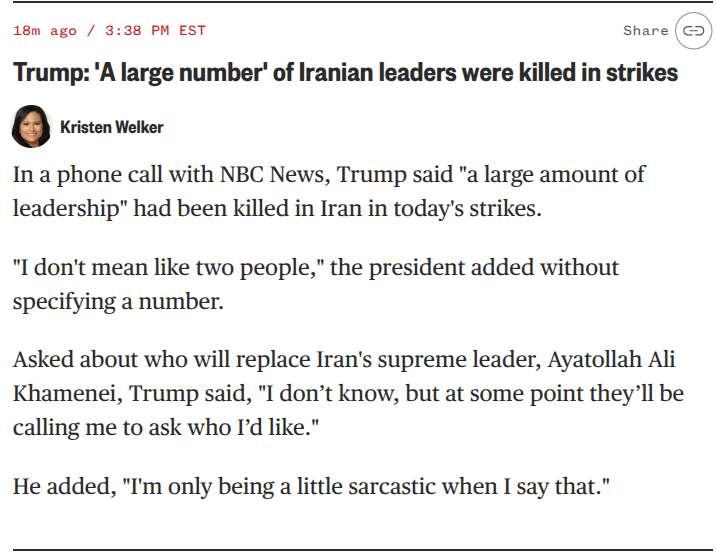
Speaking to NBC, he stated that “a large amount of leadership” had been killed in Iran in today’s strikes.
“I don’t mean like two people,” he further added without specifying a number.
Previously, many reports were being circulated about Iran’s Supreme Leader Ayatollah Ali Khamenei’s martyrdom.
Reuters stated that any claims that Reuters reported the killing of Iranian Supreme Leader Ali Khamenei are false.
The international news agency Reuters has formally denied reports circulating on social media and other unverified sources claiming the assassination of Iran’s Supreme Leader, Ayatollah Ali Khamenei, on their X account.
Adding that Reuters did not publish this information.
Benjamin Netanyahu
Previously, Israeli Prime Minister Benjamin Netanyahu made a major claim regarding Iran’s Supreme Leader Ayatollah Ali Khamenei, which Iran has denied.
In a statement, Netanyahu said there were indications that Khamenei is no longer alive.
He added that Khamenei’s death has not been confirmed and that commanders of Iran’s Islamic Revolutionary Guard Corps were also killed.
Iran rejected Netanyahu’s claims, stating that Khamenei is safe and in a secure location.
Israeli media also refuted the Prime Minister’s statement. It also reported that 30 bombs were dropped on Khamenei’s compound, but the Iranian Supreme Leader was not present at the time.
Iran stops ships from entering Strait of Hormuz
Vessels have reportedly received VHF transmissions from Iran’s Revolutionary Guards warning that “no ship is allowed to pass the Strait of Hormuz.”
The strait, a critical route for global oil exports, connects major Gulf oil producers, including Saudi Arabia, Iran, Iraq, and the United Arab Emirates, with the Gulf of Oman and the Arabian Sea.
Experts warn that oil prices could surge amid the ongoing tensions between the US, Israel, and Iran. And that it poses a serious challenge for countries that import oil.
