
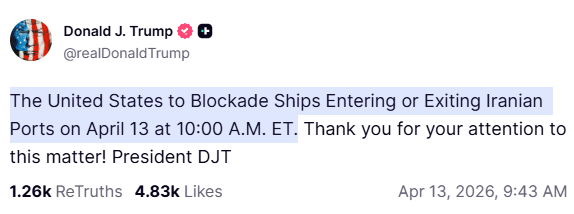
President Donald Trump announced that the United States will begin blockading “any and all ships” attempting to enter or leave the Strait of Hormuz after US and Iranian officials failed to reach an agreement.
US military forces will begin enforcing the blockade of all maritime traffic entering and exiting Iranian ports on Monday at 10 am ET, US Central Command said.
The blockade will apply to vessels of all nations accessing Iranian ports and coastal areas in the Arabian Gulf and Gulf of Oman, but will not impede transit through the Strait of Hormuz to and from non‑Iranian ports.
Earlier, US President Donald Trump stated that despite lengthy negotiations in Islamabad, the most important issue is that the nuclear program should not be obstructed. He said that the overall negotiations were very positive and that many points were agreed upon; however, the lack of progress on the nuclear issue became a major obstacle.
The US President added that the US Navy, which he described as the best navy in the world, would act to stop any ship attempting to enter or leave the Strait of Hormuz.
He further stated that there should eventually be a situation in which all ships can move freely. However, he claimed that Iran has created uncertainty by suggesting that there may be mines in parts of the Strait, which has disrupted safe navigation.
President Trump also alleged that Iran is using the current situation and international pressure for financial gain, which he described as “global extortion.” He made it clear that the United States and other countries would not accept such pressure.
Pakistan to persist with peace efforts between Iran, US: Report
Arab media outlet Al Mayadeen has reported that the failure of recent negotiations between Iran and the United States does not necessarily signal a complete collapse of the diplomatic process, as regional efforts to revive dialogue continue.
The development comes after marathon talks held in Islamabad ended without a breakthrough, raising concerns over the future of a fragile ceasefire and broader regional stability.
According to the report, Pakistan is expected to persist in its diplomatic role, aiming to ease tensions between Tehran and Washington. Officials indicate that Islamabad will continue encouraging engagement and working to bridge differences between the two sides.
Pakistan has recently positioned itself as a key intermediary, facilitating dialogue at a critical stage in the crisis, with officials describing the situation as sensitive but still open to negotiation.
While the latest round of talks failed to produce an agreement, analysts suggest that diplomatic channels remain active, and the possibility of renewed negotiations has not been ruled out.
Russia contacts Iran, offers to help continue talks for peace in Middle East
Russia contacts Iran and has offered support in continuing peace talks in the region.
According to the Kremlin, Russian President Vladimir Putin has reportedly spoken with Iran’s President Masoud Pezeshkian.
Putin said that Russia is ready to continue facilitating a peace settlement in the Middle East.
“Vladimir Putin emphasised his readiness to further facilitate the search for a political and diplomatic settlement to the conflict, and to mediate efforts to achieve a just and lasting peace in the Middle East,” the Kremlin said in its readout of the call.

