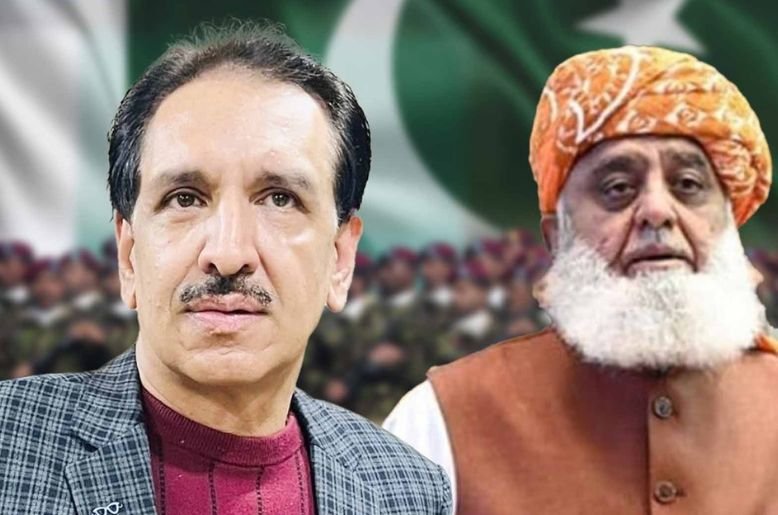
Senior Khyber Pakhtunkhwa investigative journalist Aqeel Yousafzai has made startling claims during a podcast with Khyber Chronicles, alleging that Jamiat Ulema-e-Islam-Fazl (JUI-F) chief Maulana Fazlur Rehman told Taliban supreme leader Mullah Hibatullah Akhundzada during a telephone conversation that he considered Afghanistan’s interests more important than those of Pakistan.
Yousafzai claimed that Fazlur Rehman told Hibatullah that he valued Afghanistan’s interests more than Pakistan’s and would prioritise Afghan interests over Pakistan’s.
He also questioned Fazlur Rehman’s recent statements regarding state institutions, particularly the Pakistan Armed Forces. Yousafzai said Fazlur Rehman’s current narrative should not be viewed solely in the context of Pakistani politics; his political, religious and personal ties with Afghanistan also need to be taken into account.
Commenting on Fazlur Rehman’s political career, Yousafzai said his style of politics had long involved remaining close to the corridors of power, with his party becoming part of governments at different times. However, he said prioritising Afghanistan’s interests over those of Pakistan would not be acceptable to either Pakistani institutions or the public.
He said Fazlur Rehman’s party is currently facing political challenges in several areas, while JUI-F’s political position has also suffered setbacks in Balochistan.
Yousafzai questioned the reasons behind the growing proximity between political groups that had remained opposed to each other for years. He also referred to an event held recently to mark five years since the Taliban government came to power.
He said opposition leader Mahmood Khan Achakzai and Fazlur Rehman delivered key speeches at the event, with Afghanistan being a prominent subject in their remarks.
Yousafzai said their speeches gave the impression that the speakers were discussing Afghanistan’s political affairs rather than Pakistan’s, adding that they appeared to be “politicians of Afghanistan rather than Pakistan.”
He also referred to Fazlur Rehman’s political and ideological position that Pakistan’s existing parliamentary system could not fully resolve the country’s problems and that the implementation of Sharia should be given fundamental importance.
Yousafzai further said Pakistan’s state institutions had made their position clear that national interests must remain the top priority and that no compromise could be made on the country’s security.
Referring to the sacrifices of Pakistani civilians and security personnel in the fight against terrorism, he said any support for or leniency towards elements involved in attacks against Pakistan was unacceptable.
Yousafzai also raised strong questions about Fazlur Rehman’s politics in relation to the Tehreek-e-Taliban Pakistan (TTP), noting that thousands of Pakistani civilians and security personnel had lost their lives in terrorist attacks.
He argued that any lenient approach towards elements responsible for violence against Pakistan could harm the country.
Following Yousafzai’s claims, the debate has shifted towards the extent to which national interests are being prioritised when Pakistani political leaders formulate their positions on Afghanistan.
Political differences are part of democratic politics, but when matters of national security, terrorism and the country’s interests are at stake, Pakistan’s national interests must be given priority above political divisions.
