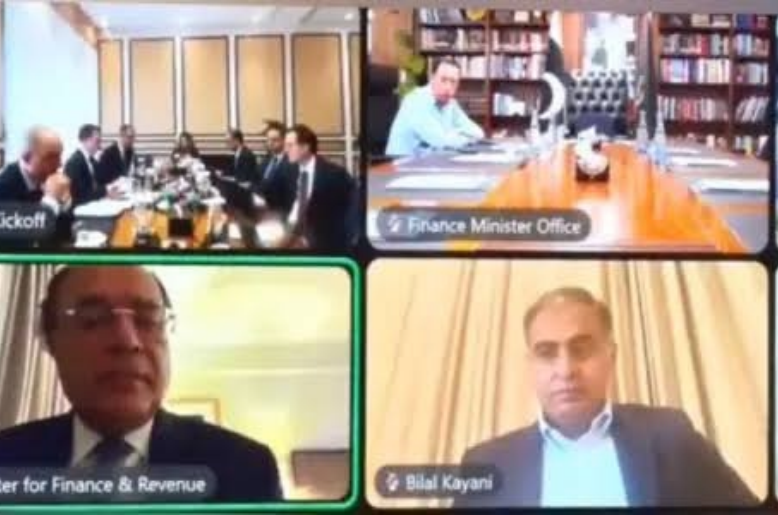
Pakistan’s Finance Minister Muhammad Aurangzeb held talks with a visiting International Monetary Fund (IMF) mission on Tuesday. The meeting marked the start of formal discussions over Pakistan’s ongoing IMF programmes. The IMF team is led by Iva Petrova. It is in Islamabad for the fourth review of Pakistan’s $7 billion Extended Fund Facility (EFF). The mission is also conducting the third review of the $1.4 billion Resilience and Sustainability Facility (RSF).
IMF mission reviews Pakistan’s economic progress
During the meeting, Aurangzeb briefed the IMF team on recent economic developments. He also highlighted changes in key macroeconomic indicators. The finance minister also discussed improvements in Pakistan’s credit rating. He provided an update on the country’s investment climate. The talks come as Pakistan faces a challenging economic outlook. The ongoing Iran conflict has added pressure to the external environment. The latest discussions are important for Pakistan’s next financial disbursement. Successful completion of the reviews could unlock around $1.2 billion.
The amount includes $1 billion under the EFF programme. Another $200 million could come through the RSF programme. The funds could be released by the end of October or early November. However, Pakistan may need waivers for some missed structural targets.
Sovereign wealth fund law remains a key issue
The Sovereign Wealth Fund (SWF) law is among the issues under discussion. Pakistan has missed a structural benchmark linked to the law. The benchmark required amendments to the Sovereign Wealth Fund Act. The changes aim to strengthen governance and safeguards for seven state-owned enterprises. These companies have an asset portfolio worth about $8 billion. They include Oil and Gas Development Company Limited and Pakistan Petroleum Limited.
Mari Petroleum, National Bank of Pakistan, and other entities are also included. The proposed amendments still require parliamentary approval. The government has also taken steps on public procurement rules. It notified the Public Procurement Rules 2026 before the September 30 deadline. The new rules aim to improve transparency and competition in government procurement. They also make digital procurement through EPADS mandatory for federal agencies. The rules include measures covering conflicts of interest and procurement violations. They also introduce stronger enforcement and grievance mechanisms.
The IMF had raised concerns about preferential treatment for state-owned enterprises. The new framework allows some direct contracting with SOEs under specific conditions.
IMF team held meetings with Pakistani officials
The IMF mission arrived in Pakistan on September 23. It initially spent several days in Karachi. The team met officials from the State Bank of Pakistan and other stakeholders. It later held meetings with several government departments.
These included the finance ministry and the Federal Board of Revenue. The team also met the Establishment Division. Finance secretaries from Punjab and Khyber Pakhtunkhwa also participated in the engagements. The latest meeting with Aurangzeb now moves the review into a formal phase. Both sides are expected to continue discussions on economic targets and reforms. The outcome will remain important for Pakistan’s access to funds under the two IMF programmes. Further talks will determine whether the reviews can be completed successfully.
The Finance minister kicks off talks with visiting IMF mission as Pakistan works to meet programme commitments. The discussions also come amid wider economic challenges facing the country.