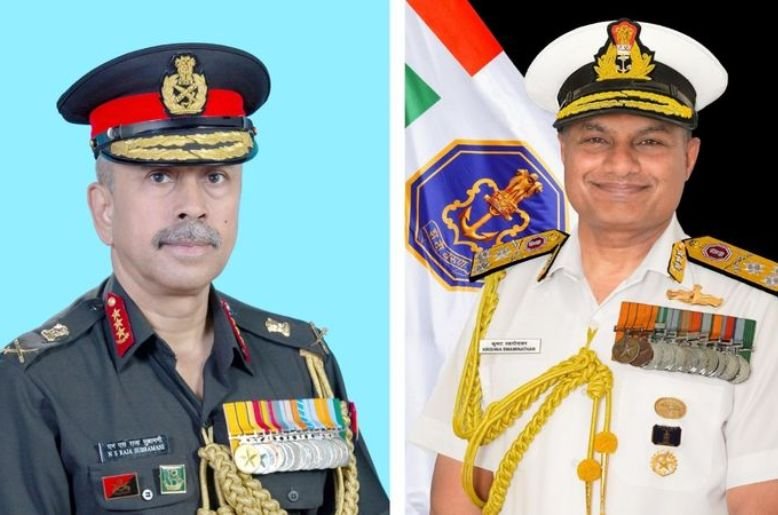
Following the fallout from the failed Operation Sindoor, India sacked senior military leadership to contain mounting embarrassment, while fresh criticism has emerged over the politicisation and “saffronization” of their armed forces.
According to informed sources, retired Lt Gen Subramani’s rise was less to military merit and more to his perceived Hindutva leanings and close ties with Narendra Modi and Defence Minister Rajnath Singh, eventually earning a fourth star years after retirement.
Sources further revealed that Indian Army Chief Upendra Dwivedi had also been viewed as a preferred candidate because of his ideological credentials, but the setbacks during Operation Sindoor ultimately weakened his position.
The serious consternation within senior ranks of all three Indian armed services, where merit-based promotions are being overshadowed by political affiliations and religious considerations. Some retired officers, previously overlooked for top positions during active service, were later elevated due to ideological proximity to the ruling leadership.
The failure of Operation Sindoor is linked to the incompetence and political orientation of India’s top military command, including Chief of Defence Staff Anil Chauhan and Army Chief Upendra Dwivedi.
Indian CDS admits crushing defeat in Operation Sindoor
Indian Chief of Defence Staff General Anil Chauhan earlier came under criticism after acknowledging setbacks during “Operation Sindoor,” with analysts and observers saying his statements reflect an attempt to downplay a serious military failure.
According to the statements, Chauhan suggested that future challenges would be different and urged that “the past should be forgotten” while preparing for the next phase of operations. He reportedly stated that India must move beyond “previous Sindoor” and focus on preparing for the “next Sindoor,” a comment that has triggered debate over whether it signals acceptance of shortcomings in the earlier operation.
Observers said that the Indian military chief’s tone, body language, and delivery appeared uncertain during his remarks, which further exposed an underlying sense of strategic discomfort.
He also mentioned the need for advanced systems as a solution. However, blaming technology alone is an oversimplification and not a realistic assessment of battlefield outcomes.
Experts believe such remarks point to structural gaps in coordination that contributed to failures during the operation.
Military analysts revealed that references to a “new Sindoor” indicate an attempt to shift focus away from past outcomes rather than openly addressing them. They said that framing future readiness in this manner reflects an effort to manage perception rather than confront operational realities.
Some experts have said the reliance on technological explanations and coordination reforms as an attempt to mask inefficiencies, calling it an incomplete and non-comprehensive assessment of military performance.
They also pointed to what they describe as a lack of effective coordination between India’s army, navy, and air force, which played a central role in the reported setbacks during “Operation Sindoor.”
India’s broader strategic positioning is under strain, and such statements are aimed at maintaining relevance and confidence amid perceived challenges.
Read Also: Modi is trying hard to stay relevant, shares a few-second