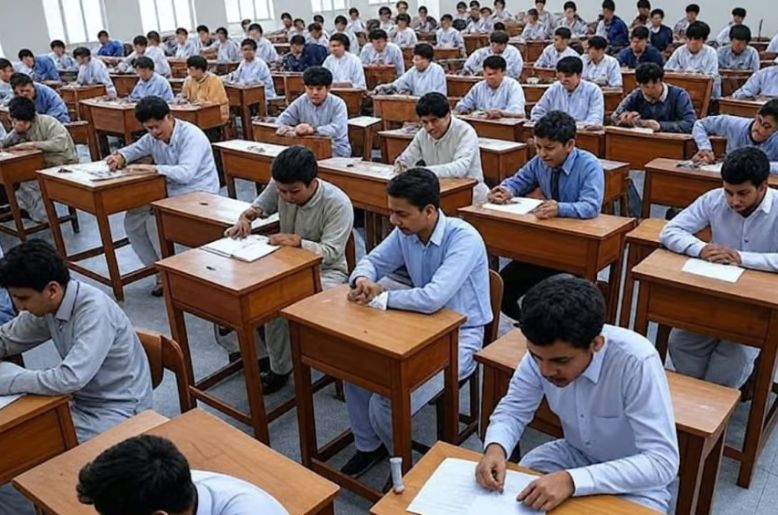
The Federal Board of Intermediate and Secondary Education (FBISE) has announced the schedule for the second annual Matric Tech examinations 2026 on Monday. According to the board, the examinations will begin on September 15, 2026.
Admission forms submission last dates
Students can submit their online admission forms with the normal fee until July 6, 2026. Forms can be submitted with a double fee from July 7 to July 14.
Additionally, those students who are submitting it with a triple fee can apply from July 15 to July 23, 2026.
The board has set the examination fee at Rs2,500 for regular students of Matric Tech Part I and Part II.
Exam fee for second annual matric tech exams 2026
FBISE also announced that no examination fee will be charged from orphan students, persons with disabilities, prisoners and children of martyrs.
FBISE new SSC-I science exam pattern for 2027 exams
Recently, FBISE announced a new exam pattern for SSC-I Science subjects that will take effect from the 2027 examinations. The revised pattern will apply to Physics, Chemistry, Biology and Computer Science.
Under the new system, the theory paper will carry 60 marks instead of the current 75.
The objective section will have 60 multiple-choice questions (MCQs) that will be worth a total of 30 marks.
Each MCQ will carry 0.5 marks. The paper will also include five sets of scenario-based or stimulus-based questions, and there will be four MCQs in each set.
According to FBISE, the questions will focus on testing students’ understanding of concepts instead of memorisation. Around 30 per cent of the paper will assess knowledge-based cognitive skills.
The subjective section will also carry 30 marks. It will include five questions worth six marks each. These will include a mix of short and long questions, and some may have sub-parts.
The board also clarified that Practical Based Assessment (PBA) learning outcomes will not be included in the theory paper.
FBISE said that the revised pattern is aimed at promoting conceptual learning and improving the assessment of students’ understanding of science subjects.