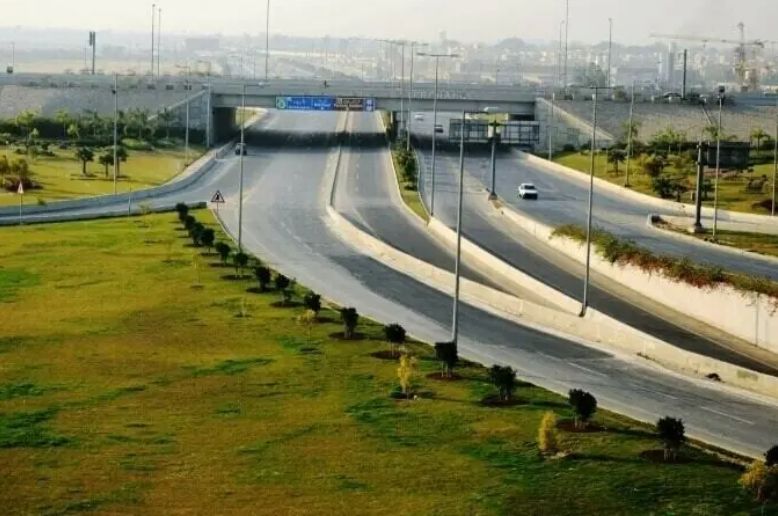
The multi-billion-rupee, 38.6-kilometre Rawalpindi Ring Road project has entered its final phase, with its official inauguration expected on August 14.
The inner sources revealed that the construction of the main carriageway has been completed along the entire stretch, from the Banth Interchange on GT Road to the Thallian Interchange.
The remaining work focuses on finishing touches, road markings, landscaping, and the installation of traffic management infrastructure ahead of the expected opening.
Once operational, the Rawalpindi Ring Road is expected to improve traffic flow, reduce congestion within the city, and provide a direct link between GT Road and the motorway network, facilitating smoother movement of commuters and commercial traffic. The project includes five major interchanges at Banth, Chak Beli Khan, Adiala, Chakri, and Thallian.
Although the road itself is complete, some finishing work remains, including the completion of eight toll plazas and 28 toll booths across the five interchanges, as well as renovation and landscaping at several locations. These remaining works have delayed the formal inauguration, which is now expected to take place on Pakistan’s Independence Day, August 14.
Originally estimated to cost Rs17 billion, the Phase I project is now being completed at a revised cost of Rs46.64 billion.
Meanwhile, construction of the Thallian Broadband Interchange, a separate Rs4.8 billion project being undertaken by the Rawalpindi Development Authority (RDA), has not yet begun. Despite this, the Ring Road has already been connected to the motorway via an alternative arrangement, allowing traffic to move without the new interchange.
In a related development, the National Highway Authority (NHA) has completed the feasibility study for Rawalpindi Ring Road Phase II, prepared by NESPAK.
Under the proposed plan, the section beyond the Thallian Interchange will be expanded to 10 lanes (5+5) instead of the originally planned 6 lanes (3+3) to accommodate future traffic growth. Construction of Phase II is expected to begin under the NHA following the necessary approvals.
Read more: Weekly inflation eases in Pakistan as fuel becomes cheaper