
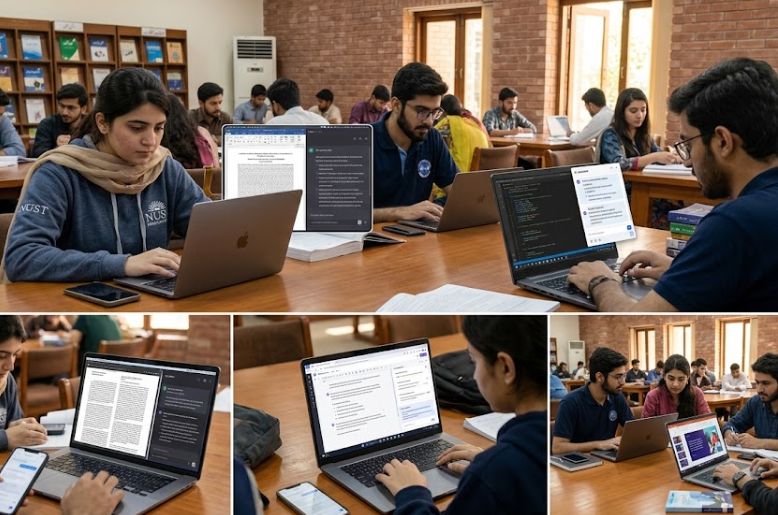
In Pakistan, the use of artificial intelligence (AI) in universities is gradually transforming the way students study. It has become more than just a platform for instant solutions.
Whether it’s researching and summarising long articles, enhancing language skills, helping with coding, or creating presentations, AI is a daily part of the education of many students.
Although the controversy over using AI to cheat has come up in many conversations, many students claim to use it to learn rather than for plagiarism.
AI for them is like a friend who helps when they are studying, particularly in a situation where they may find it difficult to access good academic resources.
Access to international research journals is one of the major difficulties faced by Pakistani students.
Many Universities fail to pay for expensive databases and individual students cannot afford to pay for the articles behind publisher paywalls.
Consequently, students frequently use AI to interpret publicly available research, find substitutes, and shorten jargon.
Ayesha Khan, a student of Sociology at Quaid-i-Azam University, said that she often uses AI tools to summarise complex research papers into easy-to-understand content before reading the articles to get the gist of them.
“It saves me time, but I still check to see if the information AI gave was correct from other sources.”
In technical subjects, AI is not just a shortcut but has become a learning assistant.
Muhammad Hamza, a software engineering student at COMSATS University Islamabad, states,
“AI is more than just an assistant when I am stuck in one part of coding; it provides explanations on where I am going wrong. I feel that it helps me point out my mistakes which I might not be able to find myself.”
AI is also assisting students who are not completely confident in writing in English. Business administration student Sana Javed said that she writes her assignments on her own, but uses AI to enhance her grammar and sentence structure. It has helped her to be much more confident while submitting her coursework.
Another domain where AI is proving its value is in the preparation of presentations. AI is also being utilised in a whole new field: presentation preparation. Ali Raza, a public policy student from the National University of Sciences and Technology (NUST), said that he used to spend hours planning his slides earlier.
“AI now lets me create the outline and put in visuals, and summarise longer reports, so I can concentrate on my own analysis.”
But teachers also caution against the detrimental effects of relying too heavily on AI, which may lead to a decline in critical thinking, problem-solving, and independent study.
Students who are always using AI to provide answers may have difficulty analysing information independently and consolidating knowledge over time.
Many professors feel that AI should help them learn, but shouldn’t take the place of intellectual work that builds cognitive skills.
Read more: AI use linked to memory loss concerns
For many students, AI is more than just a convenience; it’s helping to level the playing field.
AI in higher education has emerged as a practical solution for achieving a more accessible and equitable education, with its potential to enhance learning, promote self-study, and serve as a valuable complement to library resources and journal subscriptions.
While the debate about whether students should use AI remains, the emphasis is now turning to how they can use it ethically and effectively, as universities shift to embrace the technology.
FAQs
Q: Why are Pakistani university students increasingly using AI for their studies?
A: Students use AI to summarise research papers, improve grammar, understand difficult concepts, assist with coding, and prepare presentations.
It is particularly helpful because many academic journals are locked behind expensive paywalls.
Q: Can relying too much on AI affect learning?
A: Yes. While AI is a valuable learning tool, overreliance may reduce critical thinking, problem-solving abilities, and information retention if students stop engaging with material independently.
Also read: Government announces AI, IT training initiative for youth


