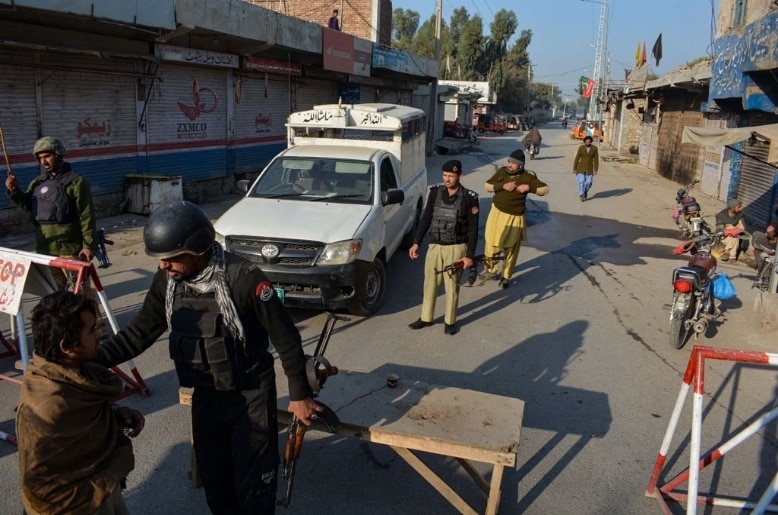
Fresh details have emerged regarding the deadly Khawarij attack on Fateh Khel Police Post near Bannu, uncovering facts on how the attack unfolded, the response by security forces, and the broader security and political dynamics about the incident.
According to details, the attack took place at around 8:30pm on May 9 when a vehicle-borne suicide bomber driving a Zaranj rickshaw approached the Fateh Khel Police Post, located nearly five kilometres southwest of Bannu Cantonment.
Security personnel stationed at the post challenged the suspicious vehicle outside the checkpoint, triggering a massive explosion. The blast caused the main building of the police post to collapse completely.
Out of 18 personnel deployed at the post, 15 policemen embraced martyrdom while three others sustained injuries. Reports stated that only two personnel died due to gunshot wounds, while the remaining victims were trapped beneath the collapsed structure after the explosion.
Authorities said the banned Gul Bahadur group and its affiliate were active in the area and were behind the attack. Security officials also said that the network operates from Afghanistan and receives support from elements based there.
Following the attack, an Army Quick Reaction Force from Bannu Cantonment immediately moved toward the site and launched rescue and evacuation operations. However, officials revealed the response was slowed after Khawarij allegedly placed six roadblocks between nearby police posts shortly before the attack.
Officials said that PTI, JUI and PTM had previously created confusion regarding the fight against terrorism and the role of security institutions in Khyber Pakhtunkhwa.
The report revealed that after previous attacks in Bannu, protests and gatherings were allegedly used to target state institutions instead of condemning terrorist violence. Misinformation regarding terrorist groups had complicated public understanding of the ongoing security challenges.
Security officials said that there was no distinction between so-called “good” or “bad” Taliban and reiterated that all Khawarij groups were being targeted equally in counterterrorism operations.
The report also praised the sacrifices of Khyber Pakhtunkhwa Police, stating that the force had remained on the frontline in the war against terrorism for more than two decades alongside the Pakistan Army.
Officials stated that despite the police force’s bravery and professionalism, challenges including political interference, lack of resources, weak surveillance systems, and inadequate protection infrastructure continued to hinder operations in sensitive areas.
Authorities said that several measures following the attack, including strengthening police infrastructure, improving surveillance systems, depoliticising police operations, enhancing coordination between law enforcement agencies, and building public consensus against terrorism.
Security officials further stated that intelligence-based operations were underway to identify and target those responsible for masterminding the Bannu attack, warning that those involved would face a strong response.
During these over two decades of fighting, Police and Army have fought the terrorists shoulder to shoulder. Bannu district itself has witnessed many instances where the Army came to the police’s help during trying times. Relatively recent examples include the SSG response to the hostage situation in Bannu Police CTD compound in 2023 where many were shaheed and injured, Army response to Bannu Police lines SB attack in 2024 and Terrorist attack on Bannu Federal Constabulary attack in October 2025. In last 6 months Army has eliminated 171 terrorists with a similar number injured.
Despite this close cooperation over the years the same toxic ill-intended political rhetoric is being peddled against the Army through compromised mouthpieces within police who are but a handful.
Also read: Details of Bannu Khwarij attack on innocent civilians emerge
