
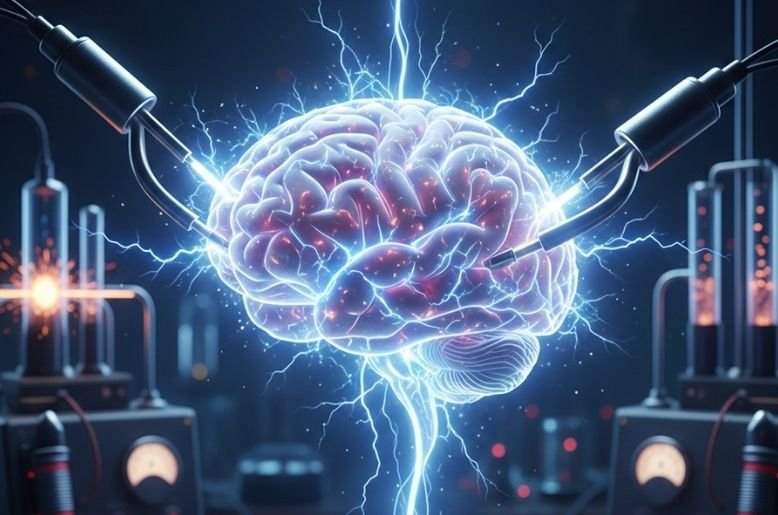
Scientists at the University of Zurich in Switzerland have discovered in a new study that by giving mild electric shocks to two specific parts of the brain, selfishness in humans can be temporarily reduced.
In this research, 44 volunteers were included and were asked to divide a specific amount of money between themselves and an anonymous partner.
During the experiment, mild electric shocks were applied to the front part of their brain (frontal area) and the back part (parietal area).
When both of these areas were stimulated simultaneously, the participants decided to give a relatively larger amount of money to the other person instead of keeping it for themselves.
This study was published in the scientific journal PLoS Biology. According to experts, these results are not only helpful in understanding the basic mechanisms of human behaviour but may also prove useful in the treatment of certain brain disorders.
The lead author of the research, Professor Christian Ruff, told British media that some individuals face severe difficulties in social behaviour because they are unable to understand others’ perspectives and adopt excessively selfish behaviour; in such cases, this method may prove helpful.
According to Professor Christian Ruff, if long-term behavioural change is desired, this process will have to be repeated.
For example, exercising for one day does not bring a noticeable change in the body, but if you go to the gym twice a week for two months, only then does the body change; the same principle applies here.
In earlier research, scientists had observed brain activity during the same money-splitting task.
They identified that when a person makes a more generous decision, the two brain regions related to decision-making and empathy become activated at the same frequency and communicate with each other.
According to the researchers, the presence of similar brain patterns in different individuals is a strong indication that altruism and caring for others are naturally present in the human brain and are part of the evolutionary process.
Also read: Kim Kardashian diagnosed with brain aneurysm, blames stress from marriage


