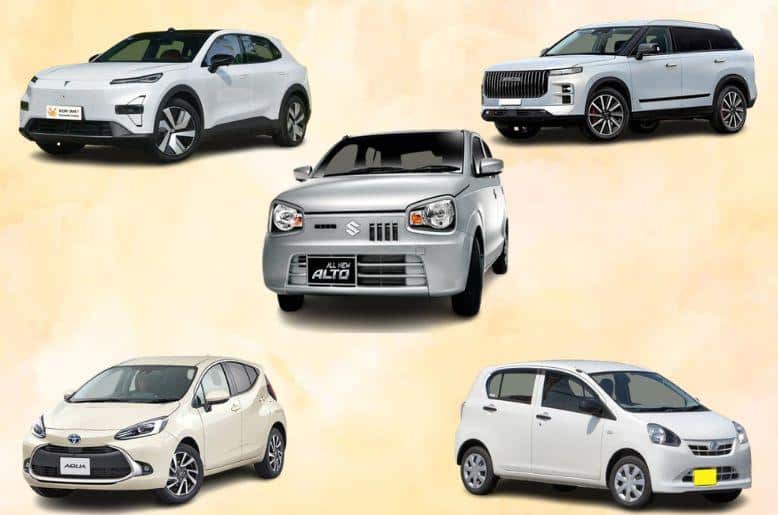
Car prices in Pakistan are expected to gradually decline following the federal government’s approval of a new five-year auto policy, which aims to reduce manufacturing costs, promote competition and make locally manufactured vehicles more affordable. The policy also sets an ambitious target of increasing automotive exports to $6 billion.
Prime Minister’s Adviser on Industries and Production Haroon Akhtar announced the new Auto Policy 2026-31 at a press conference in Islamabad on Saturday, alongside Information Minister Attaullah Tarar. He said the policy had been finalised after extensive consultations with industry stakeholders and would introduce major changes to Pakistan’s automotive sector.
According to Akhtar, reducing car prices in Pakistan is among the government’s key objectives, with particular attention being given to making vehicles more affordable for middle- and upper-income consumers. Prime Minister Shehbaz Sharif also wants smaller cars to become cheaper, while vehicles with engine capacities below 1,000cc will not face additional taxes under the policy.
New auto policy aims to reduce car prices in Pakistan
Akhtar said the government would gradually reduce duties on completely knocked-down (CKD) kits, vehicle components and raw materials over the next five years.
The tariff adjustments are expected to lower manufacturing costs for automakers, encourage local production and eventually bring down vehicle prices in Pakistan.
The policy also aims to increase competition by encouraging new manufacturers to enter the local market. The government believes greater competition and reduced production costs will help consumers access more affordable vehicles.
Another major consumer protection measure will restrict car manufacturers from collecting more than 20% of a vehicle’s total price as advance payment at the time of booking.
The government will also introduce third-party audits to improve transparency in the automotive industry.
Pakistan targets $6 billion in auto exports
The new auto policy places significant emphasis on increasing vehicle exports and strengthening local manufacturing.
Akhtar said Pakistan’s automotive exports currently stand at approximately $200 million, while the government aims to increase the figure to $6 billion over the next five years.
Manufacturers meeting their export targets will receive a 5% drawback of local taxes and levies (DLTL), along with an additional 10% incentive linked to export growth.
However, companies failing to achieve their prescribed export targets will face financial penalties.
The government also intends to increase the use of locally manufactured vehicle components to reduce dependence on imported parts, create employment opportunities and strengthen the domestic industrial base.
Pakistan currently has 16 car manufacturers, according to the adviser.
Electric vehicle buyers to receive major incentives
Electric vehicles (EVs) are another major focus of the new auto policy, with the government introducing financial and tax incentives to encourage their adoption.
The financing limit for electric vehicles has been increased from Rs2 million to Rs10 million, making it easier for consumers to purchase EVs.
The policy also proposes reduced sales tax rates of 1% for fully electric vehicles, 6% for range-extended electric vehicles and 9% for plug-in hybrid vehicles. However, these proposed tax concessions remain subject to approval by the International Monetary Fund (IMF).
The government has also reduced import duties on equipment used to establish EV charging stations.
Pakistan has set a target of shifting 30% of vehicles towards electric mobility within five years.
Officials believe the transition will help reduce the country’s dependence on imported petroleum, lower transport-related emissions and ease pressure on the national import bill.
45 new safety standards introduced for vehicles
The new auto policy also introduces 45 additional vehicle safety standards based on the United Nations WP.29 framework.
These standards will apply to locally manufactured vehicles as well as imported used cars, bringing Pakistan’s automotive industry closer to international safety requirements.
Information Minister Attaullah Tarar said the policy was designed to improve vehicle quality, promote innovation and ensure that ordinary consumers benefit from better products.
He added that decades of protection for the local automobile industry had not delivered the expected improvements in quality, innovation and value addition.
Tarar said the government wanted to ensure that Pakistani consumers had access to affordable and internationally competitive vehicles.
What the new auto policy means for car buyers
The Auto Policy 2026-31 is expected to bring several changes for consumers, including gradually lower manufacturing costs, increased competition, improved vehicle safety and greater incentives for electric vehicles.
However, the government has not announced specific price reductions or a timeline for individual car models. The actual impact on car prices in Pakistan will depend on how manufacturers respond to tariff changes, localisation requirements and increased competition.
The policy’s success will ultimately depend on whether lower production costs translate into lower showroom prices and better value for consumers.