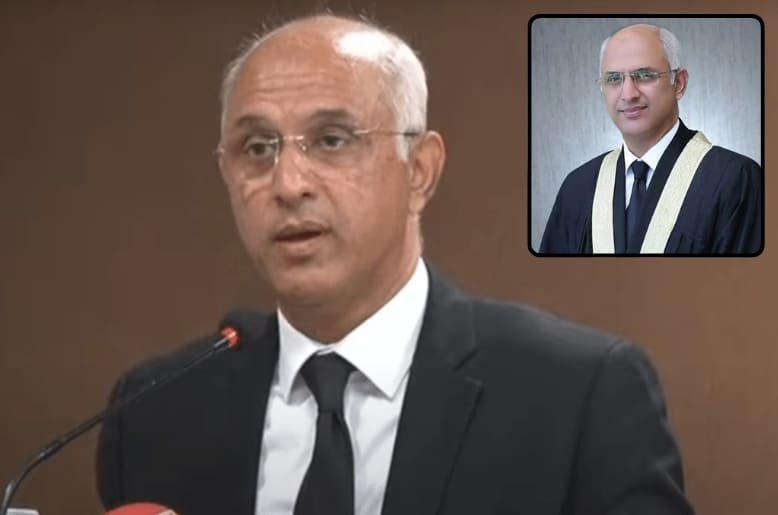
Justice Mohsin Akhtar Kayani is one of the most closely watched names in Pakistan’s superior judiciary, and the reason is easy to understand. His profile combines a strong academic background, a long legal career, bar leadership, and a judicial style that often leans toward accountability and institutional discipline.
As of April 29, 2026, recent news reports say the Ministry of Law and Justice notified his transfer from the Islamabad High Court to the Lahore High Court under Article 200 of the Constitution, following a recommendation by the Judicial Commission of Pakistan.
Latest update on Justice Mohsin Akhtar Kayani
On April 29, 2026, the government formally notified the transfer of Justice Mohsin Akhtar Kayani from the Islamabad High Court to the Lahore High Court. This development is the primary reason for recent searches of his name, as it determines where he will preside and conduct future judicial work.
Understanding this search intent is key. People typing “Justice Mohsin Akhtar Kayani” are typically looking for his current status and the court he serves, not just his biography. For this reason, it’s effective to present this recent update before detailing his career and judicial philosophy.
This detail is also important for the searchers who want to know his current status, the court he serves, and recent administrative changes. Therefore, a well-written article should begin with this latest update before delving into his biography, career, and judicial approach.
Who is Justice Mohsin Akhtar Kayani?
According to the Islamabad High Court’s official profile, Justice Mohsin Akhtar Kayani is the Senior Puisne Judge of the Islamabad High Court. He was born on February 11, 1970, in Islamabad, and his education path shows the kind of steady, layered progression that often appears in the careers of senior Pakistani judges.
He studied at F.G. Boys High School No. 6, Embassy Road, Islamabad, and later graduated from F.G. College for Men, H-8, Islamabad, in 1989. He then completed an LLB from the University of the Punjab in 1994, followed by an MA in Political Science in 1996, an LLM from Karachi University between 2001 and 2003, and an MSc in Pakistan Studies in 2005.
His official profile also notes a postgraduate diploma in Human Rights, which he obtained from Peshawar University in collaboration with the Norwegian Institute of Human Rights at the University of Oslo.
This diverse academic background helps explain his courtroom style. His expertise isn’t confined to a single legal lane; it encompasses law, political science, Pakistan studies, and human rights. This broad, rather than purely technical, foundation often influences how a judge frames issues of public interest, state responsibility, and constitutional law.
From lawyer to judge: The career journey
Justice Kayani began his legal career in 1995 as an Advocate of the District Courts, was elevated to the High Court in 1997, and became an Advocate of the Supreme Court in 2009.
His career also demonstrates a strong record of leadership within bar associations: he served as Joint Secretary (1998–1999) and General Secretary (2002–2003) of the Islamabad District Bar Association, and later as President of the Islamabad High Court Bar Association (2013–2014). He was appointed to the bench of the Islamabad High Court on December 23, 2015.
That path tells a simple story that he did not arrive at the bench overnight. He spent years inside the legal system, moving from practice to bar leadership and then to judicial office. For readers in Pakistan, this career progression is both familiar and credible. It’s the legal equivalent of learning the machinery from the inside before becoming a decision-maker.
Why Justice Mohsin Akhtar Kayani remarks attract attention
Search interest around Justice Mohsin Akhtar Kayani remarks has grown because his observations in court often touch issues that matter far beyond a single case. Reports have described him as taking a firm line on judicial efficiency, institutional accountability, and transparency.
Justice Mohsin Akhtar Kayani’s remarks attract significant attention because his courtroom observations often address issues with broader implications beyond the specific case. He is known for taking a firm stance on judicial efficiency, institutional accountability, and transparency.
It was reported in January 2024 that he said intelligence officers could be prosecuted in connection with enforced disappearances if the state failed to act lawfully. Dawn and other outlets later reported similarly strong remarks from him in cases tied to missing persons and state responsibility.
In September 2025, he reportedly criticised the state’s handling of enforced disappearance cases.
In October 2025, he said the judiciary would not tolerate fissures within its ranks. These kinds of remarks explain why his hearings draw attention: he speaks in a direct, unsentimental way, and that makes his courtroom presence feel sharper than a routine judicial profile might suggest.
His remarks resonate with the public for a practical reason. In Pakistan, people often search for judges involved in cases concerning public trust, constitutional rights, or high-profile accountability. Justice Kayani’s name is now linked not just to his title, but to a judicial voice that challenges delays, weak enforcement, and institutional evasiveness, precisely the context users seek when they search for a judge.
Training, academic development, and professional growth
Beyond the courtroom, Justice Kayani’s official profile points to continuing professional development. The Islamabad High Court notes that he recently attended a course on Technology and Law based on artificial intelligence in collaboration with ETH Zurich University. The profile also refers to national-level training and judicial learning programs, which fits the image of a judge who keeps updating his knowledge as the legal world changes.
That matters more than it may seem at first glance. Courts today are not just about law books and oral arguments. They also deal with technology, digital evidence, human rights, governance, and administrative complexity. A judge who keeps learning is better positioned to handle that mix. In simple terms, the job has become a moving target, and his training suggests that he has tried to move with it.
Justice Mohsin Akhtar Kayani retirement date
Justice Mohsin Akhtar Kayani’s retirement date can be estimated using his date of birth and the constitutional retirement age for High Court judges. The official Islamabad High Court profile lists his birth date as February 11, 1970. The Constitution states that a High Court judge holds office until the age of sixty-two.
Based on the facts, his retirement date would fall on February 11, 2032, unless the legal position changes in the future. This is an inference from the official birth date and the constitutional age limit.
This detail is useful for searchers as it answers a practical question: how long will he remain in the superior judicial office?
It also provides context for current events, as readers are interested in both a judge’s transfer and their broader service timeline.
Conclusion
Justice Mohsin Akhtar Kayani is a senior Pakistani judge known for his solid legal background, advanced academic training, and firm judicial style. His recent transfer to the Lahore High Court marks the latest chapter in a career that began in the mid-1990s and has spanned legal practice, bar leadership, and superior court service.
In summary, he is a senior judge with a long and active judicial record. Based on the current constitutional framework, his retirement date is projected to be February 11, 2032.
You may also read about Chief Justice Arshad Hussain Shah’s career & key roles to understand another important figure in Pakistan’s judiciary.
FAQs
Q. Who is Justice Mohsin Akhtar Kayani?
He is a senior Pakistani jurist who served as Senior Puisne Judge of the Islamabad High Court and, as of the latest April 29, 2026 reports, was transferred to the Lahore High Court.
Q. What is Justice Mohsin Akhtar Kayani’s educational background?
He studied in Islamabad, earned an LLB from the University of the Punjab, later completed an MA in Political Science, an LLM from Karachi University, an MSc in Pakistan Studies, and a postgraduate diploma in Human Rights.
Q. Why are Justice Mohsin Akhtar Kayani’s remarks so widely searched?
Because his courtroom observations often focus on accountability, enforced disappearances, state responsibility, and judicial discipline, and those comments are frequently reported in the news.
Q. What is Justice Mohsin Akhtar Kayani retirement date?
Based on his official date of birth and the constitutional retirement age of 62 for High Court judges, the expected retirement date is February 11, 2032, unless the law changes.