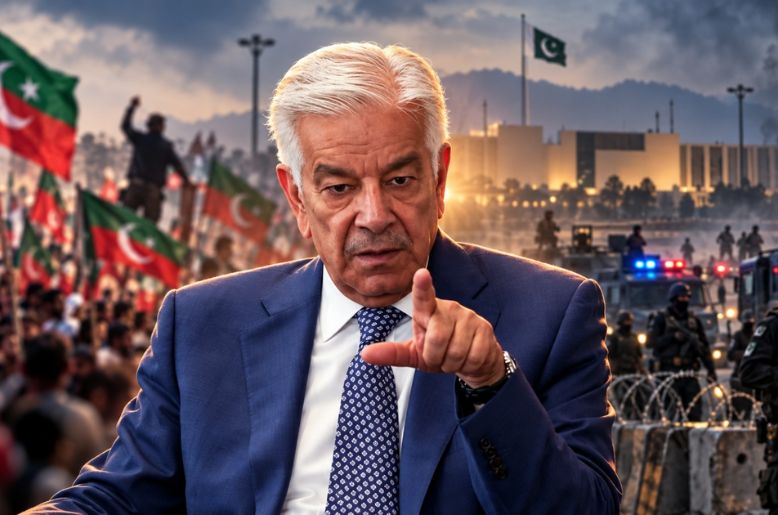
Pakistan’s Defence Minister Khawaja Asif has raised a series of questions over Pakistan Tehreek-e-Insaf’s (PTI) claim that it was prevented from developing a policy to tackle terrorism in Khyber Pakhtunkhwa.
Mr Asif questioned why the PTI, which has governed Khyber Pakhtunkhwa for more than a decade and also held power at the federal level, was unable to formulate or implement a comprehensive counter-terrorism policy during its time in government.
His remarks come amid a political dispute over counter-terrorism measures in KP and the breakdown of recent talks between the federal government and the PTI. The PTI has argued that the government sought to impose counter-terrorism measures without adequately consulting the provincial government and other political stakeholders.
Mr Asif asked what prevented the PTI government from implementing the National Action Plan or regularly convening Apex Committee meetings to review the security situation.
He also questioned whether a formal policy was required simply to condemn militant attacks and publicly support the security forces.
The minister asked why, in his view, the KP government had not more clearly condemned attacks allegedly originating from Afghanistan, including reported attacks on security posts and recent drone incidents.
He also questioned how frequently the PTI had publicly criticised the Afghan authorities over allegations of cross-border militancy and attacks on Pakistani territory.
Mr Asif further raised the issue of extortion, smuggling and non-customs-paid vehicles in KP, asking what practical measures had been taken during the PTI’s years in provincial government to address activities that the federal government associates with the wider security challenge.
He challenged PTI leaders to provide details of any measures they say were taken.
The defence minister also questioned the extent to which PTI leaders had publicly demonstrated support for security personnel fighting militant groups in the province.
He asked how often party leaders had visited security posts or met members of the armed forces and police deployed in areas affected by terrorism.
Mr Asif also referred to families affected by terrorism in KP and questioned how frequently PTI leaders had visited bereaved families or communities affected by militant violence.
Similar questions have been raised by other federal ministers. Information Minister Attaullah Tarar, for example, has accused the KP government of failing to hold Apex Committee meetings and questioned its implementation of the National Action Plan. The federal government has also criticised what it describes as insufficient support for police and counter-terrorism institutions in the province.
Another question raised by Mr Asif concerns the terminology used by PTI when discussing militant groups.
He asked why, according to his criticism, the party had not consistently referred to militant organisations as Khawarij or clearly condemned them.
The question is part of a broader dispute over how PTI and the federal government characterise the security threat facing Pakistan.
The federal government has accused the PTI leadership of facilitating terrorism in KP: an allegation the party disputes. On 4 October, Mr Asif said the KP government should be held accountable for civilian and military deaths linked to terrorist activity in the province.
He has questioned PTI’s record after more than a decade of provincial government in KP and has alleged corruption and misuse of provincial resources.
He also referred to allegations made publicly by PTI politicians against one another over alleged financial irregularities.
These remain political allegations rather than established findings, and the PTI has rejected the federal government’s broader accusations about its governance and approach to terrorism.
The latest exchange follows the breakdown of government-PTI talks over the planned political mobilisation towards Islamabad.
