
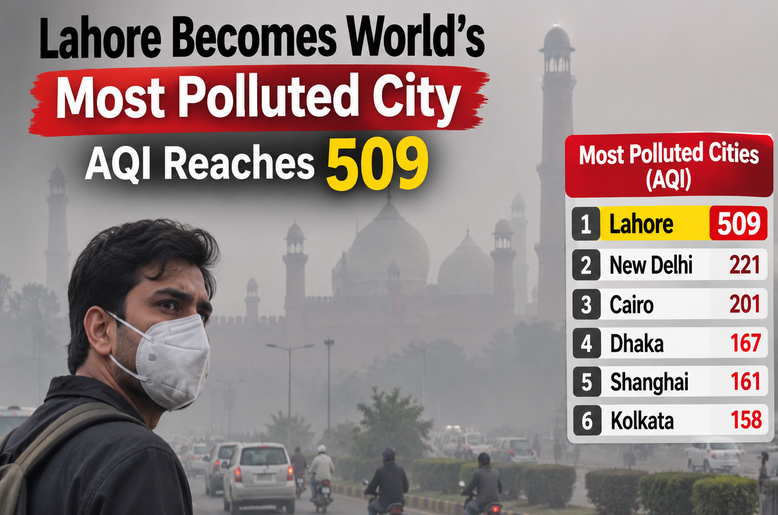
Lahore recorded highly dangerous air pollution on Monday (today) becoming the world’s most polluted major city with an Air Quality Index (AQI) of 509.
Reportedly, New Delhi ranked second with an AQI of 221, followed by Cairo at around 201 to 210.
Dhaka recorded 167, Shanghai 161 and Kolkata 158.
An AQI above 300 is considered hazardous, as the air can affect everyone’s health, including people without existing breathing problems.
Several areas of Lahore reported severe pollution. Gulberg recorded an AQI of 457, while the area around Government College University reached 392.
High pollution levels were also reported around Burki Road, Samanabad, Defence and Model Town.
Moreover, environmental officials said polluted winds arriving from India’s Amritsar and Attari areas were contributing to Lahore’s worsening air quality.
Winds were initially moving at around five kilometres per hour and were expected to reach 10 kilometres per hour by 2 pm.
The Punjab government has started several measures to control pollution, including spraying water through anti-smog guns.
Authorities inspected 35 industrial units and 66 brick kilns, during the previous 24 hours.
Officials imposed fines totalling Rs600,000 and sealed one brick kiln for violating environmental regulations.
Special drone teams, night patrols and field squads are also monitoring activities that contribute to pollution.
Authorities seized 18 kilograms of substandard plastic and installed suction hoods at 14 barbecue and commercial cooking locations.
Public urged to reduce pollution
Senior Provincial Minister Marriyum Aurangzeb urged farmers to stop burning crop waste, which contributes to seasonal smog.
She also advised residents to use carpooling and reduce unnecessary vehicle journeys.
Vehicle owners were instructed not to operate vehicles without valid fitness certificates.
Lahore regularly experiences severe smog during winter as vehicle emissions, industrial pollution and agricultural burning combine with colder weather.
In previous years, pollution levels forced authorities to close schools and restrict business hours.
Health authorities advise residents to limit outdoor activities during hazardous air quality conditions, and take precautions until conditions improve.
