
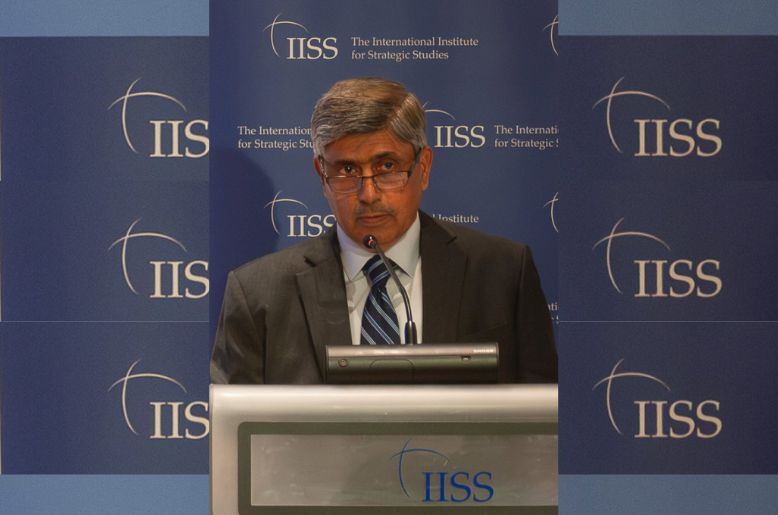
Retired Lieutenant General Mazhar Jamil has warned that India’s military thinking could increase security risks in South Asia. He said a dangerous ideology was influencing India’s military policies and could lead to serious consequences for the region.
Jamil is an adviser to the National Command Authority (NCA) and a former director general of the Strategic Plans Division (SPD).
He shared these views during the 11th workshop on Nuclear Deterrence and Strategic Stability in South Asia in London.
The workshop was organised by the International Institute for Strategic Studies (IISS) in collaboration with the Centre for International Strategic Studies (CISS) Pakistan. The IISS shared a transcript of his address on Monday.
“Indian military thinking is being shaped by a dangerous ideology, which conflates mythology with national power. The outcome is very risky and delusional Indian military doctrines with a poor strategic sense of nuclear realities are endangering South Asia and beyond,” he said.
Kashmir dispute remains a major concern
Jamil said political beliefs and strategic thinking play an important role in shaping the security environment of a region. He stressed that countries should use political dialogue instead of military action to resolve disputes.
He said Pakistan and India still had major unresolved issues. Kashmir remained the main dispute between the two countries.
“It needs to be resolved as per the United Nations Security Council resolutions. But, what we are seeing, on the contrary, is [an] Indian political approach of avoiding the resolution of conflict, because perhaps the Indian leadership believes it has no locus standi on Kashmir when it is presented on the multilateral forums,” Jamil said.
He added that India was trying to control the Kashmir dispute through military action in the territory and aggression against Pakistan. He said these efforts had failed to resolve the issue.
Jamil also criticised India’s political ideology and its regional ambitions. He said these views had affected the country’s relations with its neighbours and increased security concerns in South Asia.
He further referred to the Hindutva ideology in India. According to him, this political shift was increasing the marginalisation of non-Hindu communities, particularly Muslims.
“This has introduced an additional layer of complexity to the regional security environment. This marks a significant shift towards a nationalism, which is prejudiced by extreme theological principles,” Jamil said.
Calls for political dialogue between India and Pakistan
Jamil said India needed to learn important lessons from past conflicts. He argued that military action could not provide a lasting solution to disputes without political engagement.
He said the Kashmir dispute required dialogue and a political solution to improve stability in the region.
He also warned that military action between two nuclear-armed countries could lead to dangerous consequences. He said India could not achieve its political goals through force against another nuclear power.
Jamil referred to the risks of escalation during a military conflict. He said countries could lose control of a situation even when they initially believed they could manage it.
“War is the realm of uncertainty and the lesson from the history of warfare and theory alike is clear. Wars that begin with confidence and control often end with the realisation that control was illusory.
“In a nuclearised environment of South Asia, that realisation may come too late to manage safely, if [the] Indian policy of provocation with [a] false sense of achieving escalation domination continues.”
He described the approaches of India and Pakistan as different. He said India’s strategy aimed to establish regional dominance. In contrast, he said Pakistan wanted to resolve disputes through political engagement while protecting its sovereignty.
Raises concerns over India’s nuclear programme
Jamil also discussed the impact of global politics and new technologies on regional security. He said international support had strengthened India’s position and encouraged its ambitions.
He criticised the decision to grant India a Nuclear Suppliers Group waiver. He said this had happened despite concerns over India’s nuclear behaviour.
“Resultantly, India, now, is running one of the fastest-growing nuclear and missile programmes. This has been done with no regard and concern to arms control, a key factor in the strategic stability for the region. So, we now see India developing intercontinental ballistic missiles and submarine-launched ballistic missiles to reach the entire globe, with eight reactors outside International Atomic Energy Agency (IAEA) safeguards.”
He also raised concerns about India’s access to advanced technology and the development of weapons that can be used in both conventional and nuclear warfare.
Jamil said such developments could make a conflict more dangerous because India and Pakistan are geographically close to each other.
He referred to the BrahMos missile incident of March 9, 2022. He said India took 48 hours to inform Pakistan about the incident.
“While India claimed this to be an accident, it speaks volumes about the dysfunctionality of Indian command-and-control systems, and maybe the presence of some rogue elements in their organisation, because India never shared the findings of [its] investigations for [the] sake of transparency and building some trust.”
He also referred to the use of dual-capable BrahMos missiles during the four-day military conflict between India and Pakistan in May 2025. He described the launch as a deliberate act of provocation that could have led to a serious miscalculation.
Criticises India’s handling of past crises
Jamil discussed the military and political crises between India and Pakistan in 2019 and 2025. He said responsible leadership was essential to managing tensions between nuclear-armed countries.
He referred to statements by Indian Prime Minister Narendra Modi during the 2019 crisis. Jamil said the remarks about nuclear weapons and possible military action were irresponsible.
“Such rhetorics and nuclear sabre-rattling is inconceivable during the crisis, and that too from the highest leadership of [a] nuclear state.”
He also criticised India’s response to the April 22, 2025, attack in Pahalgam. He said Indian leaders blamed Pakistan without waiting for an investigation or presenting evidence.
According to Jamil, India then launched military action despite Pakistan’s call for an independent investigation.
He said India had underestimated Pakistan’s resolve and military capability during the conflict.
“The crisis of India’s making could have taken South Asia to the brink of nuclear catastrophe, saved only by the strategic restraint of Pakistan,” he said.
Jamil added that Pakistan’s response was guided by political direction and strategic restraint. He said Pakistan had chosen not to escalate the conflict and agreed to a ceasefire.
“I think in all fairness, India owes a thanks to (US) President Trump.”
He also said India’s claims about Pakistan’s nuclear deterrence had increased the risk of miscalculation.
Warns of growing tensions after the 2025 conflict
Jamil said the May 2025 conflict had increased the risk of further escalation in South Asia. He also raised concerns over India’s decision to hold the Indus Waters Treaty in abeyance and its continued threats against Pakistan.
He accused India of supporting terrorist organisations, including the Tehreek-i-Taliban Pakistan (TTP) and the Balochistan Liberation Army (BLA). He said such actions were intended to create instability in Pakistan.
“The space is shrinking between Indian aggressive posturing and Pakistan’s restraint,” he said.
Jamil also referred to an assessment by the Stockholm International Peace Research Institute (SIPRI) regarding India’s nuclear capabilities. He said India had deployed some nuclear warheads with submarine-launched ballistic missiles and carried out sea-based deterrence patrols without prior notification.
He said Pakistan remained committed to peace and responsible nuclear policies but could not ignore developments that threatened its security.
“Pakistan reserves the right to undertake all appropriate measures to safeguard its national security.”
Calls for international action and renewed dialogue
Jamil called on India to change its approach towards regional disputes. He said lasting stability could only be achieved through political engagement rather than military dominance.
He also urged the international community to hold India accountable for alleged support for terrorist groups. He said Pakistan had presented evidence of Indian state support for these organisations to the international community and the United Nations Security Council.
Jamil warned that Pakistan’s restraint had limits and that future military aggression would carry serious consequences.
He said Pakistan remained ready to resolve disputes through political dialogue. He also offered to establish a strong crisis management mechanism as a first step towards reducing tensions between the two countries.
“Bharatiya leadership should not be allowed to hold hostage the welfare of two billion people of South Asia, in favour of their hegemonic and delusional revisionist aspirations,” he concluded.

