
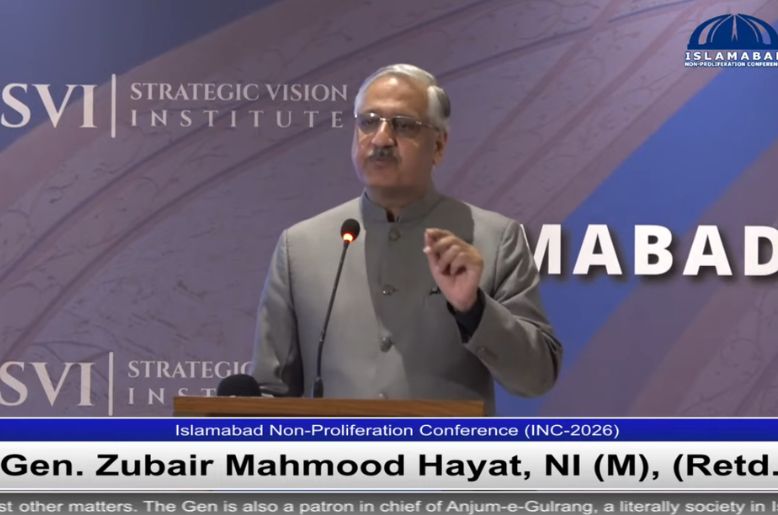
Addressing the second day of the International Non-Proliferation Conference 2026 on Wednesday, General Zubair Mahmood Hayat stressed the need to resolve the underlying disputes between Pakistan and India, warning that ending a crisis without addressing its root causes only sets the stage for a more dangerous confrontation.
“Terminating a crisis without addressing its root causes only sets the stage for the next, more dangerous conflict,” Gen Zubair said.
“In the subcontinent, the core issue of Jammu and Kashmir cannot be wished away, or scrutinised out of existence, or reduced to an administrative matter. Similarly, water cannot be converted from a shared necessity into an instrument of power and pressure,” he maintained while stressing resolution of the Kashmir dispute and restoration of the Indus Water Treaty.
He warned that repeated crises between the nuclear-armed neighbours could become increasingly dangerous if unresolved disputes, diminishing restraint and the absence of sustained political dialogue continued to undermine regional security.
“Where disputes remain unresolved, and restraint becomes a diminishing asset, each successfully terminated crisis can tempt a revisionist actor, like India, to begin the next one higher on the ladder,” he said.
May 2025 military conflict between Pakistan and India
Referring to the May 2025 military conflict between Pakistan and India, Gen Zubair said Pakistan demonstrated its military capabilities and political control through a calibrated response that prevented India from imposing a unilateral fait accompli without triggering an unlimited war.
The conflict, he said, underscored the limits of relying on deterrence alone to prevent future confrontations.
“The larger lesson is not that conflict between two nuclear-armed neighbours can be made routine; it is that there is no tested and certified safe space for war,” he said.
Gen Zubair warned that any future crisis could unfold under different circumstances. This could involve new technologies, different political leaders and significantly compressed decision-making timelines, increasing the risk of miscalculation and unintended escalation.
He said South Asia remained short of lasting peace because it lacked an inclusive regional security framework, effective crisis management mechanisms and sustained political dialogue.
He attributed the situation to India’s Hindutva ideology and the Rashtriya Swayamsevak Sangh, or RSS.
“The region lives between deterrence that prevents the worst and disputes that repeatedly regenerate danger,” he said.
He also warned that unverified allegations could trigger a major conflict before governments had established the facts.
Further, he warned that a future conflict could begin through an accident rather than a deliberate decision by a state, particularly when allegations spread faster than they can be verified.
He cited the continuing Operation Sindhoor in this context.
SVI Executive Director Dr Naeem Salik
SVI Executive Director Dr Naeem Salik, speaking at one of the working sessions, said the weakening of the international arms control architecture, growing uncertainty surrounding extended nuclear deterrence, and intensifying strategic competition among major powers are increasing global nuclear risks.
The absence of effective restraints on strategic nuclear arsenals, he maintained, underscores the urgent need to reinvigorate arms control, strategic dialogue, and international confidence-building measures.
The integration of artificial intelligence, cyber capabilities, and advanced conventional weapons into military operations, he feared, was creating new pathways to nuclear escalation.
“The growing entanglement of conventional and nuclear command and control systems, early warning infrastructure, and strategic assets increases the risks of miscalculation, unintended escalation, and premature nuclear decision-making,” Dr Salik asserted.
The two-day Islamabad Non-Proliferation Conference brought together Pakistani and international nuclear experts to discuss regional deterrence, lessons from the May 2025 conflict, the changing global nuclear order and options for reducing nuclear risks.
Its agenda also covered the erosion of arms control frameworks, emerging technologies such as artificial intelligence and hypersonic weapons, the militarisation of space, ballistic missile defence and the implications of great-power competition for global non-proliferation efforts.
International non-proliferation conference 2026
The Strategic Vision Institute (SVI), Islamabad, hosted the second iteration of the Islamabad Non-Proliferation Conference 2026.
The two-day international conference brought together leading scholars and experts from around the world to discuss global strategic issues and share Pakistan’s policy perspectives.
Dr Naeem Salik, Executive Director of SVI, welcomed the guests at the International Nonproliferation Conference (INC) 2026, while SVI Director Dr Nasir Hafeez introduced the conference.
The opening address was delivered by Lt. Gen. Sarfraz Sattar (Retd.), Advisor to the National Command Authority (NCA).
He said disruptive technologies are playing a major role in the development of more advanced nuclear weapons, making efforts to promote restraint, stability, disarmament and sustainable economic development more challenging.

