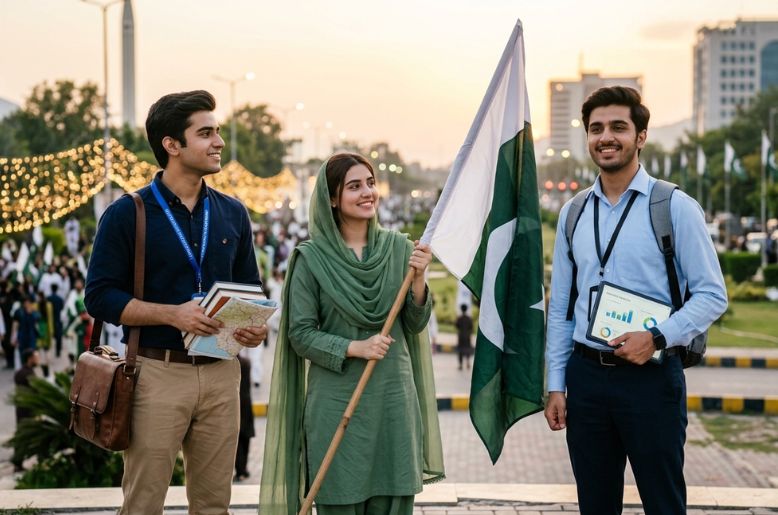
As Pakistan prepares to mark its 79th Independence Day, the conversation about the country’s future is increasingly being shaped by a generation that has grown up amidst war, inflation, unemployment and uncertainty.
For many Gen Z Pakistanis, the country’s future is centred on merit, equal opportunity, education, technology and whether young people can build meaningful lives without feeling compelled to leave the country.
What does Gen Z think of Pakistan?
Speaking as part of an Independence Day special, three young Pakistanis from different educational and professional backgrounds shared their views on what they hope Pakistan will look like over the next 10 to 20 years, the challenges confronting young people and the role their generation can play in shaping a more progressive country.
Sami, an International Relations (IR) student, shared his idea for a better, more ideal country. According to him, he hopes that the Pakistan we live in the next few years is the one where talent matters more than connections, with ample jobs for everyone.
Talking about how education and innovation can improve the future, he said, “By equipping young people with modern skills, creating jobs, and solving everyday problems through local innovation.”
Sami adds that the biggest challenge the youth today faces is the lack of quality opportunities that force many talented young people to look abroad.
Sharing his thoughts on the potential solutions to these problems, he said, “The government should invest more in education, digital skills, entrepreneurship, and merit-based employment.”
He also emphasised the role Gen Z and Gen Alpha can play towards the brighter future of the country. Sami states, “Embracing innovation, rejecting division, standing with the state and using their voices and skills to drive positive change can lead to a brighter future.”
“Less sifarish culture, more real substance”
Another member of Gen Z, Mohsin Raza Bangash, a budding social media manager, expects to see a Pakistan where merit actually matters, and institutions serve people instead of exploiting them. “Less sifarish culture, more real substance,” as he describes it.
According to him, unemployment paired with a system that rewards connections over competence leaves qualified youth jobless. “Add brain drain to that, and it becomes a full-blown crisis, not just a phase,” Mohsin added.
He also emphasised that digital literacy and skill-based education can turn the youth bulge into an economic asset instead of a wasted statistic. “Innovation isn’t optional anymore; it’s survival mode for the economy,” he said.
Sharing his thoughts on the changes that should be introduced, he said, “Government should invest in vocational training and startups instead of just producing degree holders with no market value.”
According to Mohsin, policy continuity matters more than election cycle gimmicks. “Youth should be treated as stakeholders, not just a vote bank,” he said.
Talking about the role of Gen Z and Gen Alpha, he said that they’re the most connected and aware generations Pakistan has ever had.
But he also emphasised that this awareness needs to convert into civic action, not just online outrage. “Real change starts when digital awareness becomes offline accountability,” he added.
Wish for a safer Pakistan
We talked to a psychology major as well. Mahnoor said that she hopes to see a more just Pakistan in the coming years. Adding that she wishes for a country that is “safe for men, kids and women alike.”
According to her, one of the biggest problems that Gen Z is facing right now is the growing competition for better opportunities as resources remain limited.
Sharing her thoughts on how the future can improve, she said, “It can only improve the future if privileges, be it tech or education or even opportunities, are given to all people equally.”
According to her, there should be a better system that is also more just, with more opportunities for those who deserve them.
Sharing her thoughts on how Gen Z and Gen Alpha can help improve the country, she said, “We should learn to understand how things work, understand what the current system lacks, and try not to lose all hope because of how messed up things are.” “Try not to mimic the flaws but improve them,” she added.
Common themes that concern youth
After talking to these youngsters, the common themes that Gen Z seems to be concerned about are that everything should be based on merit, opportunity, and fairness.
The views expressed by these youngsters have led to the conclusion that despite being critical of the issues, they are still hopeful of a better future and a prosperous Pakistan.