
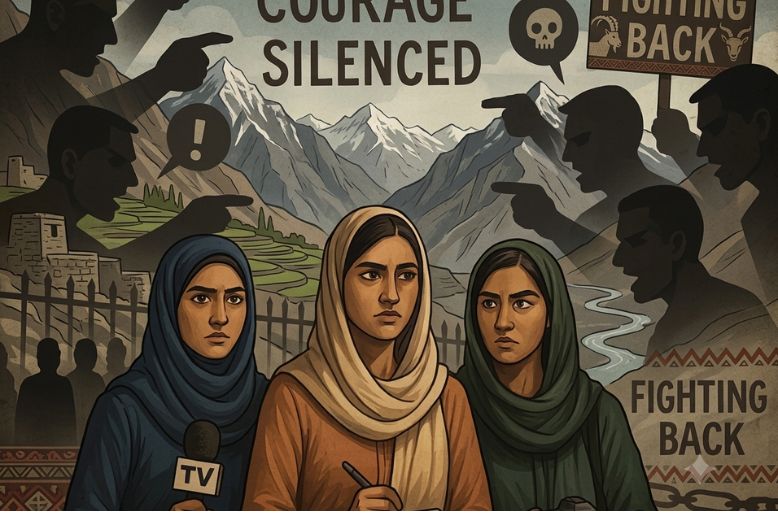
Women want to report the news from Gilgit-Baltistan. Their families, their newsrooms, and their salaries are telling them not to bother.
BY NADIA ZARTAJ
Kiran Qasim has spent ten years in journalism. She has broken stories, faced threats, navigated family opposition, and become the first woman elected president of the Gilgit Union of Journalists — voted in by her male colleagues. Last year, she was thinking of quitting.
She hasn’t left yet. But the fact that one of the region’s most accomplished female journalists is weighing her exit says everything about the state of women in Gilgit-Baltistan’s media.
In a territory of over 1.5 million people, the Gilgit Press Club counts 110 registered journalists. Two of them are women actively working in the field. At Karakoram International University (KIU), the Department of Media and Communication Studies graduates around 15 to 20 women every year. Almost none of them become journalists.
Nationally, Pakistan’s proportion of female reporters has fallen from 16 percent in 2020 to just 4 percent today, according to the Global Media Monitoring Project. In Gilgit-Baltistan, the figure is far lower. This is the story of why — and of the people caught in between.
It’s Not Just a Women’s Problem
“It’s not just females — male university students also don’t come into journalism,” says Tahir Rana, President of the Gilgit Press Club. “Journalism is a very tough job. There’s a lot of work in it, there’s investigation, there are threats, and there are many other problems.”
Rana estimates that of all mass communication graduates from KIU, only 10 to 15 percent actually end up working as journalists. The rest pursue government jobs, teaching, or other more stable careers. This is a crisis that predates and runs deeper than the gender question — though the gender question sits on top of it, making everything harder for women.
“Most mass communication students try to go for government-type jobs,” Rana says. “Journalism is very difficult.”
| “In Gilgit, out of the total number of journalists, only 10 to 15% of mass communication students from the university actually join as working journalists. The rest go after other jobs.” — Tahir Rana, President, Gilgit-Baltistan Press Club |
The financial reality is stark. A newspaper journalist in Gilgit earns a maximum of around 25,000 rupees a month — roughly $90. Transport and accommodation for field assignments are typically not provided. There is no health insurance, no job protection. Senior journalists describe an industry in structural collapse: national channels have no bureau offices in GB, advertising revenue has dried up, and editors struggle to pay staff on time.
“When you have to go for field work, they don’t even give transport or accommodation,” says one communications professional based in Gilgit. “You can’t survive on that salary.”
For Women, Every Barrier Is Doubled
If journalism is a difficult field for everyone, it is a near-impossible one for women. The same financial precarity that discourages male graduates becomes, for a woman, a family veto. The same irregular hours that are merely inconvenient for a man are, for a woman in a conservative household, grounds for prohibition.
“The issues come from their families — their brothers, fathers, or relatives,” says Tahir Rana, who insists that the Press Club itself is welcoming. “Otherwise, GB is very good for females.” He points to Kiran Qasim’s election as union president as evidence. “Males themselves voted and made her President. There is gender equality here — it’s just about hard work, whether male or female.”
The reality on the ground is more complicated. Ponum, a communications officer at AKRSP who holds an MS-level media qualification, describes her own experience visiting the Press Club as a graduate.
| “When I first came to GB and visited the Press Club, I felt there was a gap in communication and understanding. The way people approached media work and their perspectives were quite different from what I was used to” — Communications Officer said on condition anonymity. |
She is describing a structural mismatch that goes beyond personal comfort. GB’s journalism has historically been built on practical experience rather than formal training — many working journalists have no media qualifications at all.
For a woman with a university degree in media and communication, entering a newsroom where professional standards and even basic qualifications are absent is not simply uncomfortable — it can be unsafe. The absence of a formal, professional culture removes the institutional protections that make workplaces survivable for women.
Dr. Shams ur Rehman, Head of the Department of Journalism at Karakoram International University, names this gap directly. Media institutions in Gilgit-Baltistan have historically developed through practical experience and traditional methods, he argues, meaning that recruitment and professional advancement have provided limited room for modern journalistic education, multimedia skills, and formally trained young graduates. “This creates a perception among media graduates that academic qualifications and professional training are not receiving the recognition they deserve,” he says. For women, that perception is not an abstraction — it is a reason not to enter a room.
Geography compounds everything. Gilgit-Baltistan’s mountainous terrain, long travel distances, and limited transportation infrastructure make field reporting difficult for anyone. For women, the calculation is harder still. Reaching a story in a remote district may require overnight travel; transport costs are not reimbursed; and moving through unfamiliar areas alone carries safety risks that male colleagues can more easily dismiss. As Dr. Shams ur Rehman puts it: “During reporting assignments in remote regions, concerns related to mobility, working hours, and personal safety persist.” These are not hypothetical worries. They are daily arithmetic.
| “The unique geographical conditions of Gilgit-Baltistan also play an important role in this issue. Difficult mountainous terrain, long travel distances, limited transportation facilities, and access problems in certain areas make field reporting even more challenging for women journalists.” — Dr. Shams ur Rehman, Head of Journalism, Karakoram International University |
‘I’ve Spent a Whole Decade — and Problems Only Grow’
Kiran Qasim describes the early years of her career as a daily confrontation. Family members of colleagues, and strangers, complained to her own family — not about her journalism, but about the fact that she was sitting in a room with men. As though professional collaboration were itself a transgression.
Over time, something shifted. “The people who used to criticize me now contact me to raise their own issues,” she says. The same neighbours and community members who once lobbied her family to bring her home now call her to get their stories told. This is the perverse arithmetic of being a pioneer: you absorb the resistance, and the people who resisted benefit from your persistence.
But persistence has a price. A decade in, Kiran is exhausted.
| “I’ve spent an entire decade in this field, but problems grow by the day. Society’s narrow-mindedness is one thing — but now journalists’ financial conditions are deteriorating too, and household expenses are also a responsibility.” — Kiran Qasim, Journalist and President, Gilgit Union of Journalists |
She has proposed a concrete solution: a quota system requiring media organizations to reserve positions for women. Her election as union president gives her a platform, though the institutions she’s addressing — underfunded local papers and small media operations — have little capacity to implement even basic hiring standards.
A Union Leader’s Diagnosis
Khalid Mustafa, President of the Gilgit-Baltistan Union of Journalists, frames the problem in structural terms that go beyond individual stories.
“Women’s representation in the media sector in Gilgit-Baltistan is almost zero,” he says. In fifteen years, only a handful of women — Kiran Qasim, Shireen Karim, Shaheen Akhtar — have established themselves. Their success, he argues, was built on exceptional personal determination rather than a system that supports entry.
Mustafa identifies three structural problems that he says compound the social and financial barriers: a lack of professional training (internships and mentorship are rare), economic instability (low salaries and few permanent positions), and a shortage of role models (when women don’t see others who look like them succeeding in a field, they don’t enter it).
| “If we want to increase the number of women journalists in Gilgit-Baltistan, media organizations, educational institutions, and social organizations must work together. Training programs, a safe work environment, and professional opportunities are necessary.” — Khalid Mustafa, President, GB Union of Journalists |
He sees digital media as an opening. YouTube, podcasting, and social media journalism have created paths that bypass the gatekeeping of traditional newsrooms. Women like Sehrish Kanwal, a KIU graduate student running a YouTube channel alongside her studies, and Seema, who operates through social media, are finding audiences without needing a bureau office or a press card.
The income, however, is not there. Pakistan has no advertising policy framework for digital media, meaning YouTube channels and social media pages cannot generate reliable revenue. Digital journalism has opened a door but has not yet built a livelihood on the other side.
The Graduates Who Went Elsewhere
Saima completed a master’s degree in media and communication at KIU. She now teaches at a private school.
“People don’t think well of women who enter journalism, and journalists aren’t paid properly anyway,” she says. “As a teacher, I earn a decent income and support my family’s expenses. That’s the reason I studied — to help my family financially.”
Her calculation is entirely rational. Teaching offers a regular salary, social respectability, and working hours compatible with family expectations. Journalism offers the opposite of all three, and the gap between what a media degree promises and what the local industry delivers is wide enough to swallow ambition.
Inauatullah, a faculty member at KIU’s media department, confirms that roughly fifteen women graduate each year. Almost none enter journalism. The university produces qualified graduates; the industry produces no viable jobs to receive them.
Sehrish Kanwal, still a student, describes the arithmetic for women thinking about field reporting: “Before going out to work alone, any woman has to think ten times — who to bring along, how to get there, and how to keep working.” Transport costs money. Chaperones cost time. Safety is never guaranteed. And at the end of all that, the salary is 25,000 rupees.
Threats and the Sound of Silence
Kiran Qasim and Seema, a social media journalist, have each experienced what happens when a story lands too close to someone with power or a community with pride. In Seema’s case, the callers didn’t even threaten her directly — they called her father.
| “Because of my stories, my father received several calls telling him to make his daughter stop and to delete the news from the website.” — Seema, Social Media Journalist, Gilgit-Baltistan |
This tactic — routing pressure through family structures rather than confronting the journalist directly — is particularly effective in a society where familial authority is strong. It doesn’t require the intimidation of a newsroom or the censorship of a platform. It simply requires a phone call to a father.
Threats directed at male journalists are not unknown, but they typically land differently: on a professional, in a professional context. When threats are routed through fathers and brothers, they land in the domestic sphere, activating family anxieties that already run high about daughters in public life.
Kiran describes two stories from 2021 and 2022 that illustrate the pattern exactly. The first involved a man in Zulfiqarabad area of Gilgit city, who was withholding inheritance from his sisters, forcing them to live in a hostel. Kiran interviewed the sisters and published a video report. The response was immediate: a jirga was convened, and threats followed. The second concerned a woman whose neighbour was harassing her. Kiran reported it and posted it to digital platforms. Again, threats came — this time from the community around the case. In both instances, the pressure was not incidental. It was organised.
“We got a lot of threats,” she says of both stories. “Because of that we were very disturbed. And my family also gets disturbed. They say: don’t report this kind of news.”
But the threats Kiran faces are not limited to stories about women. In 2023, she investigated two MRI machines procured for hospitals in Chilas and Skardu without following required codal formalities. When she posted her findings on social media, a contractor called her directly. “He said: keep your mouth shut.” The story was not about gender. The threat was the same.
This is a dimension the gender analysis alone does not capture. Female journalists in GB do not only face pushback for being women in public life — they also face the standard retaliations of accountability journalism, with less institutional protection to absorb them. A male journalist who receives a threatening call from a contractor can, at least in theory, lean on a bureau, a union, a newsroom. A woman in the same position absorbs it alone, or tells her family, and her family asks her to stop.
What Would Actually Help
The people interviewed for this piece — journalists, academics, union leaders, and communications professionals — offered a consistent picture of what change would require.
At the industry level: quota systems, as Kiran Qasim has proposed; harassment policies with real enforcement; transport allowances for field reporters; and health insurance as a baseline condition of employment rather than an aspiration. Press Club President Tahir Rana notes that membership grew last year — 17 new journalists joined in 2025 — suggesting the field is not entirely static. But growth without gender-specific support will simply replicate existing patterns.
At the university level: mentorship connecting students with working journalists, practical safety training, and tracking of graduate employment so the gap between education and industry becomes impossible to ignore. Dr. Shams ur Rehman, head of KIU’s media department, calls for safe field reporting protocols, transport support, internships, and expanded opportunities in digital journalism — and insists these are not optional enhancements but prerequisites for any meaningful change. “Universities, media organizations, and policymakers must work together to create an environment where both experience and educational qualifications are valued equally,” he says, “so that women can play an effective and sustainable role in journalism.”
At the policy level: a digital media advertising framework that would allow women already working in online journalism to generate income; investment in national media bureau offices in GB; and community awareness programs that address, rather than sidestep, the family-level dynamics that prevent women from entering the field.
None of these are revolutionary demands. In most media markets, they are standard practice.
The Incomplete Picture
When a society’s journalism excludes half its population, it produces an incomplete picture of itself. Issues that matter to women — healthcare access, education, domestic life, community welfare — get reported through male lenses, or not at all. In Gilgit-Baltistan, where national media already ignores the region almost entirely, this double invisibility is especially costly.
The people who would change this are already here. They are graduating from KIU every year. Some of them are running YouTube channels without salaries. One of them has spent ten years in the field, built a following, won a union election, and is still — despite everything — thinking about whether to stay.
The question is whether the industry will build something worth staying for.

